

Things, not strings. Google announced that shift back in 2012. It is 2026, we have AI Overviews and large language models, and your brand can still be nothing more than a typo to an algorithm – a string of characters with no identity. You may have an impressive track record, but… you have no entity.
What is a Knowledge Graph?
A Knowledge Graph is a network of connected meanings. The nodes are entities (people, companies, places, concepts), and the lines are the relationships between them:
…works at…
…is the author of…
…specializes in…
It started on May 16, 2012, when Amit Singhal, then Google’s SVP of Engineering in charge of Search, published a post that rewrote the logic of the entire search engine. For years, Singhal had dreamed of building the “Star Trek computer” – a system that does not match strings to pages, but understands what you are actually looking for.
The graph launched under the banner:
“things, not strings”
– meaning, in short, concepts over character strings.
- At launch: 500 million objects and 3.5 billion facts.
- Seven months later: 570 million entities and 18 billion facts.
- By May 2020: five billion entities and 500 billion facts.
- By Kalicube’s estimates, March 2024 saw more than 54 billion entities and 1,600 billion facts.
What matters is no longer how much content you have in the index, but whether Google knows that you are the one working in this field – and whether it can assign you attributes and relationships.
The graph is actively pruned
Google does not only add entities. It also removes them. According to Kalicube’s analysis, June 2025 brought the largest drop in entity count in a decade: more than 3 billion units removed in a single week (6.26% of the entire graph). Jason Barnard called it the “Great Clarity Cleanup.” The data points to a shift in emphasis from accumulation to unambiguity: the share of entities with a single, definitive type rose from 23.9% to 28.7%, while the count of entities labeled “thing” shrank by 15.27%.
In practice, simply being in the graph is not enough. An entity has to be legible and unambiguous, or it risks dropping out at the next cleanup.
What is a Knowledge Panel?
Most people who ask me about the Knowledge Panel confuse it with a Google Business Profile – something you “set up.” But there is no registration form here. The panel is not your declaration; it is the algorithm’s answer, which appears once Google has gathered enough consistent signals to identify you unambiguously.
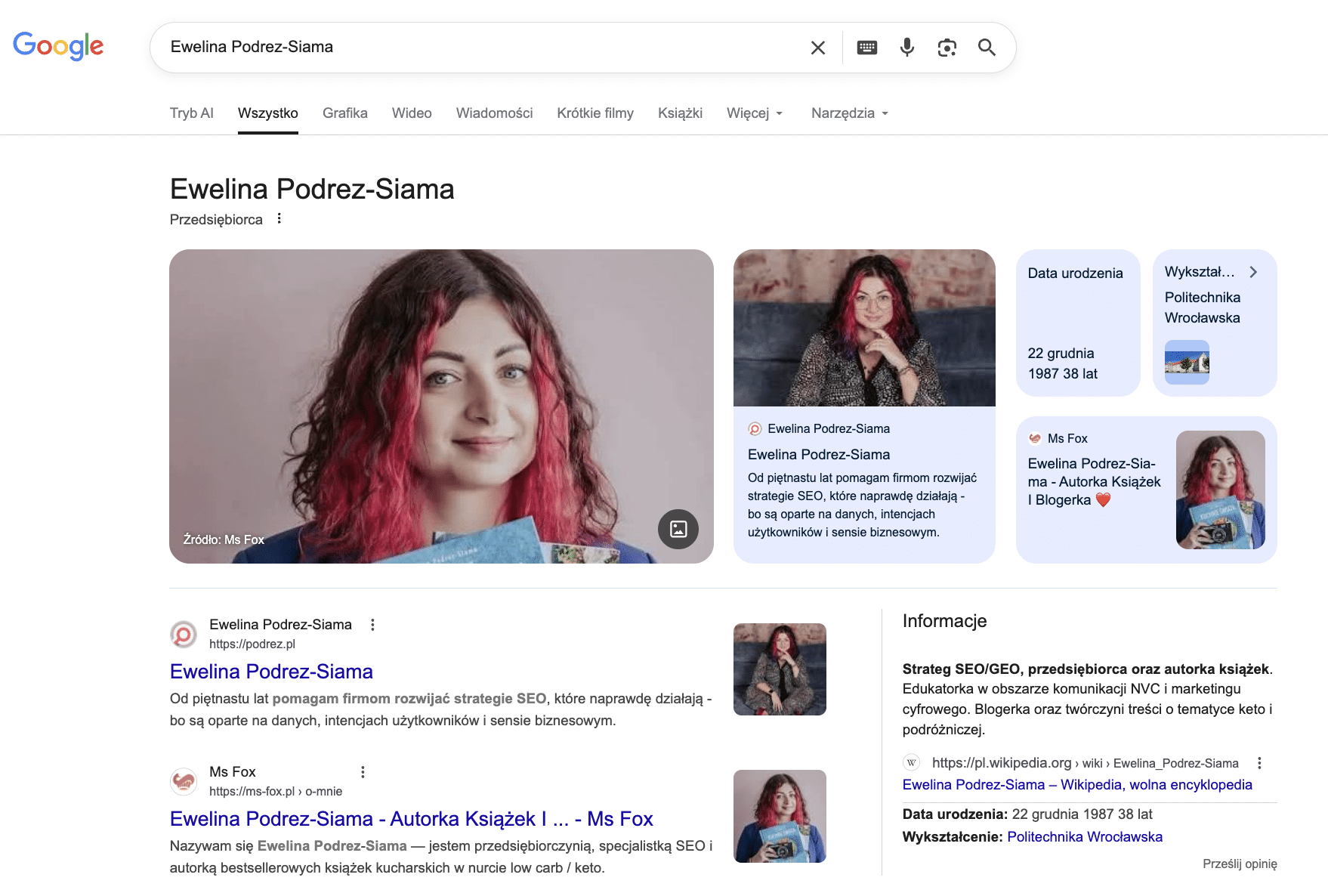
On desktop, the Knowledge Panel usually shows up at the top and on the right-hand side of the search results (on mobile it may be woven in between results). It holds a range of elements, including a photo, a description, links to profiles, related people, and topics. And it is not the same as rich snippets (star ratings, product prices, or recipe photos are the result of structured data on a specific page).
The panel describes the entity as a whole, built from many sources at once – as in the example above, where you can see content drawn from Wikipedia, podrez.pl, and ms-fox.pl.
Where the panel’s data comes from
Google builds the panel primarily from external sources, such as:
- Wikidata – an open database of facts that Google actively draws on
- Wikipedia – the content of an entry can reach the panel surprisingly fast
- Media mentions, citations, and independent sources
This is not a closed list. Google states that it draws on hundreds of sources: material from across the web, open and licensed databases, and structured data published by site owners themselves.
How fast does it work? My Knowledge Panel appeared about 12 hours after I completed my Wikidata entry. A few weeks later, when my entry on Polish Wikipedia went live, its description reached the panel in under an hour.
But here is what matters: this is not a fixed timeline. The reaction time depends on how many consistent signals Google already holds in the graph – the more independent confirmations of your identity (publications, mentions, citations), the faster the panel can appear. If your entity is blurry – Google has the signals but cannot connect them – tidying up your Wikidata data may be the missing link that triggers the panel sooner than you expect. That is exactly what happened in my case.
How to claim your Knowledge Panel
If you already have a panel, search for your name in Google or enter the address https://www.google.com/search?kgmid=/g/11md2bpb8_ (replacing my ID with your own from the Knowledge Graph API – more on that shortly), click the three dots in the top-right corner of the panel, and select “Claim this knowledge panel.”

Google will ask you to verify your identity – most often through linked official profiles and accounts. In my case, the process also involved a selfie with my ID and confirmation that I had access to the relevant social media accounts. Once verified, you can also suggest changes to the panel.
Sometimes the panel exists, you have claimed it, and Google still shows something else for your name. Mine had been live for about two and a half months, yet in my area a search for my name kept showing a Google Business Profile I had set up myself years earlier. How I confirmed it and why I finally deleted that profile is in the case study Knowledge Panel Not Showing?
What if the panel shows incorrect data?
As a verified panel owner, you have a “Suggest an edit” button. But Google will not change a fact simply because you ask it to – you have to point to a public, independent source (a link to an interview, a Wikidata entry, a public register) that confirms your version, along with the specific passage where it appears.
It is the same logic that runs through most of my posts: the algorithm trusts what others say about you more than what you type into a form yourself.

The Knowledge Panel is not the only surface in the results that reveals whether Google understands your entity. Alongside it, “People Also Ask” sections appear more and more often – questions linked to your name, generated mainly from patterns in user queries.
The mechanism is different from the panel (closer to analyzing search sessions than to the knowledge graph), but the effect is similar: if someone searches for your name, PAA can surface questions about your company, your books, or your specialty – provided Google has something to build them from.
Three layers of signals that build an entity
Where does Google get its facts about you? From three independent layers. And here is the interesting part: their strength grows in inverse proportion to your control – the less you can influence a source, the more the algorithm trusts it.
Layer 1: structured data on your own site
I start with your site, because it is the only source you fully control. And, paradoxically, the weakest of the three.
Structured data is code in which you declare to the algorithm who you are and what you are connected to – in a form legible to bots and invisible to users. The format: JSON-LD embedded in the page code (usually in the head, though Google also supports the body), following the schema.org standard.
The key Person properties for a personal brand:
- sameAs – ties your profiles (LinkedIn, Wikidata, social media) into a single entity
- knowsAbout – defines what you specialize in
- worksFor – links you to an organization
- alumniOf / award – affiliations and distinctions as proof of authority (and when you are consistently marked up as the
authorof an article or book, the algorithm receives orderly information about authorship – proof of expertise then becomes the combination of that declaration with the content itself, your reputation, and external confirmations)
The sameAs property plays a particularly important role in resolving the problem of homonyms. Take a common name like Krzysztof Rutkowski – which happens to be the name of both the head of Ads at Fox Strategy and a well-known Polish TV personality. In the knowledge graph there may be many entities sharing the same character string, some of them very strong thanks to heavy tabloid coverage.
The sameAs property ties your page to a unique Wikidata identifier (QID), your LinkedIn profile, and your other sites. And it is those connections that tell the algorithm which Krzysztof Rutkowski is you. Without them, Google sees a name. With them, it sees an entity.
The strongest signal is a two-way relationship: your page points to a profile, and the profile links back to your page. A one-way sameAs in your code, with no confirmation from the other side, is a declaration – not proof.
Layer 2: external databases
Now for what you control less. And that is precisely why the algorithm takes these sources more seriously. The Search Quality Rater Guidelines – the instructions for the people who assess result quality (not a direct description of the algorithm, but an important signal of how Google defines trust) – explicitly flag the conflict of interest: self-made declarations require confirmation from more independent sources.
The first source worth starting with is Wikidata – the Wikimedia Foundation’s open knowledge base, with more than 1.65 billion statements, indexed by Google and by language models alike. Google actively goes looking for people in external databases like this one.
An important caveat: Wikidata is not an SEO directory or a place for self-promotion – an entry is justified only when the entity meets the project’s notability criteria and can be described on the basis of independent, verifiable sources.
According to Kalicube’s analysis: between May 2020 and March 2024, the number of Person-type entities in the graph grew 22-fold. The largest increase in the March 2024 update (38%) involved roles to which Google can attach E-E-A-T signals: researchers, writers, academics, and journalists. Company entities grew only 5-fold.
Layer 3: mentions and entity co-occurrence
The third layer is the hardest to build. And that is exactly why it is the most valuable.
Google can recognize the context in which your name appears – even beyond classic links. Patent US20180046717A1 (Related Entities, 2018) describes a mechanism for identifying entities related to a query, drawing among other things on user behavior, search results, and relationships between entities.
This does not mean every link-free mention works like a link. It does show, though, that relationships between entities can be modeled more broadly than through the hyperlink graph alone.
Citations in industry media, interviews, guest articles, conference mentions – all of it builds the context of your entity. You do not need a link. It is enough for your name to appear in the right thematic neighborhood, regularly and consistently.
Knowledge Graph and LLMs – two maps, a similar effect
Google has a knowledge graph built on verifiable sources, parts of which we see in panels, results, and the API. LLMs build internal representations from training data – with no explicit database, on the basis of patterns – or they pull data live during a web search (RAG). The mechanism differs, but the effect is similar: if you are not a coherent entity with attributes and relationships, no system will build your reputation for you.
For your brand, that has a concrete meaning: if someone asks an LLM about you with a false premise (say, “Is Kowalski the social media specialist?”), a model without hard data is more likely to confirm than to correct. Knowledge graphs reduce this problem, because they give models verifiable facts instead of patterns to guess from.
Google’s generative experiences tie language models ever more tightly to the search engine’s systems – in the case of AI Mode, Google explicitly states that it uses the Knowledge Graph, among other things.
For AI Overviews the mechanism is described in more general terms, but the direction is similar. In my own case, the changes in AI Overviews answers were clearly noticeable not long after my resultScore in the Knowledge Graph improved.
When a user asks about a specific person, a well-described entity gives the system steadier points of reference: attributes, relationships, sources. When those are missing, the answer more often rests on fragments of pages found in the index – which gives you less control over the narrative about you.
Working on your entity is not “SEO or AI.” It is the foundation of visibility in both systems.
The Knowledge Graph is a system of connections between entities – the database on which Google bases its understanding of who is who.
The Knowledge Panel is a surface that presents selected information about an entity in the search results – built on the Knowledge Graph and on other sources Google trusts.
The Knowledge Graph Search API is a diagnostic tool: it lets you check which entities Google returns for a given query, but it does not give you full insight into the whole graph.
These tools will come in handy
Check your entity
Three tools, three functions: verification in the raw data → a simplified check without the console → a visualization of your connections as a graph.
Google Knowledge Graph Search API
The most precise source. It returns the entity type, a description, related URLs, and a resultScore – a relevance score for the returned entity. In practice, you can read it as a rough signal of how unambiguously Google matches a query to a given entity.
How to check the score and read it: the API itself is at developers.google.com, and the step-by-step walkthrough and a score calculator are both in one place, in From String to Entity. Here I will add just two things: a kg:/… identifier does not guarantee a panel in the results, and a unique name earns a high score more easily than a common “John Smith”, where the API has to choose between many entities.
Knowledge Graph Search Tool
A tool by Jakub T. Jankiewicz from the WikiZEIT project – an educational initiative on ethical SEO in Wikipedia. Easier to use than Google’s raw API: you type in a query and get a result without configuring Google Cloud or logging into the developer console. A good starting point if you have no experience with APIs.
→ https://wikizeit.edu.pl/tools/graf-wiedzy/Knowledge Graph Visualiser – Roman Rozenberger
An interactive entity visualizer with Wikidata integration, built by Roman Rozenberger (AI & Automation Manager, SensAI Academy mentor). Powered by D3.js, it shows your entity as a graph: nodes, relationships, attributes. This is the tool I use to visualize my own entity – the same graphs you will find in the book.
→ GitHub · → Demo
What this means for your brand
The Knowledge Graph and the Knowledge Panel are the layer that more and more of what people see rests on when they search for information about you – in Google, in AI Overviews, in the answers of language models.
For years I ran a blog, spoke at conferences, and published books – and even so, my entity in the Knowledge Graph was blurry. I was not short on content; I just had no control over how the algorithm tied those signals into a single identity. I tell the full story of that process, with the data and the narrative of every step, in my book (in Polish). Here, I will leave you with three questions worth starting from:
1. Does Google know who you are, or does it just see your name?
Check your resultScore in the Knowledge Graph API. An empty result, or no kg:/ identifier, means the API is not returning a stable, unambiguous entity for you. Wikidata is one of the first steps toward tidying up your signals.
2. Do your three layers of signals all say the same thing?
Structured data on your site, your Wikidata entry, mentions across the web – if schema.org says “SEO strategist” while the media write “blogger,” the algorithm sees an inconsistency.
3. What would be left if you deleted your own content?
If your posts, articles, and recordings vanished tomorrow, what would the algorithm know about you from independent sources? If the answer is “not much,” you have a durability problem, not a visibility one.
Sources
- Amit Singhal, “Introducing the Knowledge Graph: things, not strings”, Google, May 16, 2012.
- Jason Barnard, “Google’s great clarity cleanup: 3 shifts redefining the Knowledge Graph and its AI future”, Search Engine Land, August 18, 2025.
- Jason Barnard, “Unpacking Google’s 2024 E-E-A-T Knowledge Graph update”, Search Engine Land, May 7, 2024.
- Kalicube, “Google Knowledge Graph: algorithm updates and volatility”.
- US Patent US12321706B2, “Soft knowledge prompts for language models,” granted June 2025.
- US Patent US20180046717A1, “Related Entities,” 2018.
- Google, Search Quality Rater Guidelines.
- Stanford HAI, AI Index Report 2026 – Responsible AI.
