

Google doesn’t want to just answer queries anymore – it wants to point to content it can vouch for. That ambition has a framework: E-E-A-T – Experience, Expertise, Authoritativeness, Trustworthiness. And it has a widely missed implication: the framework describes you, not just your text. Which is why this article spends less time on the four letters everyone has already read about, and more on the question that actually matters: how does an algorithm verify any of it?
What E-E-A-T is – and what it isn’t
E-E-A-T is not a ranking factor. It’s a quality framework that Google’s ranking systems use to recognize credible content. There is no separate “E-E-A-T algorithm” and no single score attached to your site. There is a set of signals which, taken together, build a picture of a page – and of the person behind it – as a source worth trusting.
The four components, briefly, because you’ve likely met them before:
- Experience – has the author actually done, used, or lived the thing they write about? First-hand knowledge, not compiled knowledge.
- Expertise – does the author have demonstrable competence in the topic: education, practice, a documented body of work?
- Authoritativeness – do others in the field treat this person or site as a reference point?
- Trustworthiness – the anchor of the whole family: is the page accurate, honest about who’s behind it, and safe to rely on? The Search Quality Rater Guidelines call Trust the most important member of the group – the other three exist to support it.
Google’s own helpful content documentation reduces it to questions any author can ask themselves: is this written by someone with real experience of the topic, would the reader feel they’ve learned from a person who knows the subject, and would they trust this site with a decision that matters? Simple questions. The hard part is that Google doesn’t take your word for the answers.
The framework Google’s own AI guide never mentions
Here’s the 2026 twist. In May, Google published its official guide to optimizing for generative AI search – and the term E-E-A-T doesn’t appear in it once. No Experience, no Expertise, no author. For a framework that has anchored Google’s quality rhetoric since December 2022, that’s a loud silence.
I don’t read that silence as “trust stopped mattering”. I read it as a division of labor between documents: the AI guide describes the mechanics of access (RAG, query fan-out, crawlability), while the reputation layer stays where it always lived – in the helpful content documentation and the Search Quality Rater Guidelines. The framework didn’t disappear. It just isn’t handed out as a checklist, because a checklist for trust would become a checklist for manipulation within a quarter.
In my book I put the underlying mechanism this way:
Google doesn’t try to “read” authorship from the text – it verifies it. Among other things, it compares what a page claims with what it already knows about the entity. If your Google account, your Knowledge Graph profile and your author bios form one coherent picture – you are an entity that can be verified, and trusted.
Verification, not declaration – that’s the practical meaning of E-E-A-T. A bio saying “renowned expert with years of experience” is a declaration. The algorithm checks it against sources you don’t control: the Knowledge Graph, Wikidata, independent mentions, the consistency of your identity across the web. Which raises the operational question this article exists to answer: what do you give an algorithm to verify?
The guidelines tell raters to base an E-E-A-T assessment on three sources examined separately: what the website or content creator says about themselves, what others say about them, and what is visible on the page itself. And they instruct raters to be skeptical of self-claims where a conflict of interest exists — a “review” from the product’s own manufacturer counts for less than one from an independent user, for exactly that reason.
In practice: everything you write about yourself — your bio, your case studies, your client list — sits in the first bucket, the one the rater is told to treat as a starting point, not as evidence. It can be one hundred percent true and still weigh less than the same sentence written by someone with no reason to praise you. Which makes external signals the one category where no conflict of interest is presumed from the start.
The algorithm’s trust isn’t a product of what you say about yourself. It’s a product of what the web says about you — consistently, over time, in credible company.
See Google’s guidelines (PDF)Authority triangulation: institutional, market, substantive
Authority triangulation is establishing three distinct kinds of authority – institutional, market, and substantive – so that credibility doesn’t rest on a single source. One alone is fragile. Three, all pointing at the same person, are hard to dismiss – for a journalist, a search engine, or a language model. Notice what all three have in common: every one of them lives outside your own site – in the category of signals where no conflict of interest is presumed. I developed the framework while cleaning up my own entity, and described the full process in my book; here is the mechanism.
Institutional authority
Institutional authority is confirmation from organizations the algorithm already knows and trusts – universities, industry bodies, conference juries, professional associations. In my case: being a guest lecturer at WSB Merito University and chairing an industry awards jury. The point isn’t prestige for its own sake. Institutions are strong, well-documented entities in the knowledge graph – and a verifiable connection to them lets some of that established trust reflect on you. It roughly feeds the “A” in E-E-A-T: others, bigger than you, treat you as competent.
Market authority
Market authority is a verifiable connection between your entity and the brands, clients, partners and media you have actually worked with. Not the sentence “I’ve worked with major brands” – that’s a declaration. A documented link between your entity and theirs: named clients, bylined articles in recognizable media, partnerships that exist in structured data and independent sources. This is the layer that mostly carries Trust: entities with reputations of their own vouching, by association, for yours.
Substantive authority
Substantive authority is the documented body of work itself – books with ISBNs linked to their publishers’ entities, publications, talks, the declared fields of work backed by output the algorithm can find. This is Expertise and Experience in verifiable form: not “I know SEO”, but a shelf of artifacts connecting your name to the topic, year after year.
The rule behind all three
As much evidence as possible. As little declaration as possible.
Why triangulation and not just “collect signals”? Because the three types fail differently. Institutional authority can be narrow (one university, one committee). Market authority can be dismissed as commercial. Substantive authority alone is invisible if nobody independent confirms it. Each leg covered by the other two – that’s what makes the structure hard to dismiss, and hard to fake. When I rebuilt my own entity, this was the step where the real work happened: instead of asking Google to believe me, I started supplying evidence it could check on its own, from sources independent of me. What that looked like signal by signal – and what it did to my Knowledge Graph scores – is in the book; the shape of my entity before and after is something you can inspect yourself in From String to Entity.
One caution before you build
Triangulation works on true connections. Every link in the triangle is checkable – that’s its entire value. An invented client, an inflated role, a “partnership” the partner has never heard of doesn’t just fail verification – it poisons the signals that were real. The framework rewards people who have actually done things and never organized the proof. It has nothing to offer the reverse case.
E-E-A-T in practice on small sites
E-E-A-T is not reserved for big portals. A small site can earn high quality assessments if it shows who stands behind the content and why that person can be trusted. Four examples from my own projects:
podrez.pl – the site you’re reading. Every article is signed with my full name and role, the author bio links to books and selected channels that document expertise, and the Person structured data carries a complete picture: position, social profiles, connected projects, sameAs links to Wikidata and the Knowledge Graph. Nothing exotic – just no gaps between what the page claims and what external sources confirm.
ms-fox.pl – my keto food blog, running since 2016, with three cookbooks that became bestsellers in Poland. A completely different niche than SEO, and that’s the point: consistency within a topic over years built a recognizable culinary entity, which – once properly connected to my Person entity – strengthens the whole rather than diluting it.
bornholm-online.pl – a small, niche travel site: my own trips, my own photos, official sources cited. Human first-hand experience, exactly what the “first E” describes. It’s a deliberately hard example – the niche is tiny – and that’s the point: according to Senuto data from July 2026, the site holds an AIO potential score of 142 with a 48% citation rate in AI Overviews. A blog this small, cited in roughly half of its AI Overview opportunities, isn’t winning on scale. It’s winning on being the verifiable source in its topic.
madera-online.pl – the youngest of the set, launched in February 2026, built the same way: my own trails, my own photos, information kept current. Five weeks after launch, Poland’s national media – breakfast television and a major weekly’s travel section – cited it as a source during the closure of Madeira’s hiking trails. That’s the strongest E-E-A-T signal a site can earn: independent editorial confirmation, the exact “what others say” category from the rater guidelines – arriving before the site had any link profile to speak of. (How a new domain gets there that fast is the subject of Trust Halo.)
Where to start: the verification checklist
Work through these in order – each item is something an algorithm can check without asking you:
- Visible bylines with a role on every substantive article – full name plus function, not just a first name in the footer.
- An author page that acts as evidence, not a business card: books, talks, publications, each linked to its source.
- Person structured data with
sameAsconnecting the site to your profiles, your other projects, and your Wikidata item – one entity behind many surfaces. - One consistent description of who you are across profiles, bios and directories – consistency is what makes verification cheap.
- The triangle audit: list your institutional, market and substantive proofs. Any leg empty? That’s your roadmap – not more content, more evidence.
- Check what the verification produces: your name in the Knowledge Graph, your Knowledge Panel and its behavior on your branded query – if it exists and doesn’t show, the blocker may be something you set up yourself years ago.
The minimal version of point 3 fits in a dozen lines. This is not my full markup (that one runs to about 300 lines and lives across four domains) – it’s the skeleton every element of the checklist hangs on. Drop it into your page wrapped in a script type="application/ld+json" tag:
{
  "@context": "https://schema.org",
  "@type": "Person",
  "@id": "https://podrez.pl/#person",
  "name": "Ewelina Podrez-Siama",
  "jobTitle": "SEO Strategist",
  "url": "https://podrez.pl/",
  "sameAs": [
    "https://www.wikidata.org/wiki/Q133444548",
    "https://www.linkedin.com/in/podrez/",
    "https://ms-fox.pl/"
  ],
  "knowsAbout": ["SEO", "entity SEO", "generative engine optimization"]
}
One practical note on checking it: use the Schema Markup Validator at validator.schema.org, not the Rich Results Test. The Rich Results Test checks eligibility for rich results – and a Person block on its own isn’t one, so the test will report “no items detected” and you’ll think your markup is broken when it’s fine. Different tools, different questions.
E-E-A-T doesn’t reward writing about expertise. It rewards leaving proof of it in places the algorithm independently trusts – and keeping that proof consistent long enough for verification to become trivial. The four letters are Google’s. The evidence has to be yours.
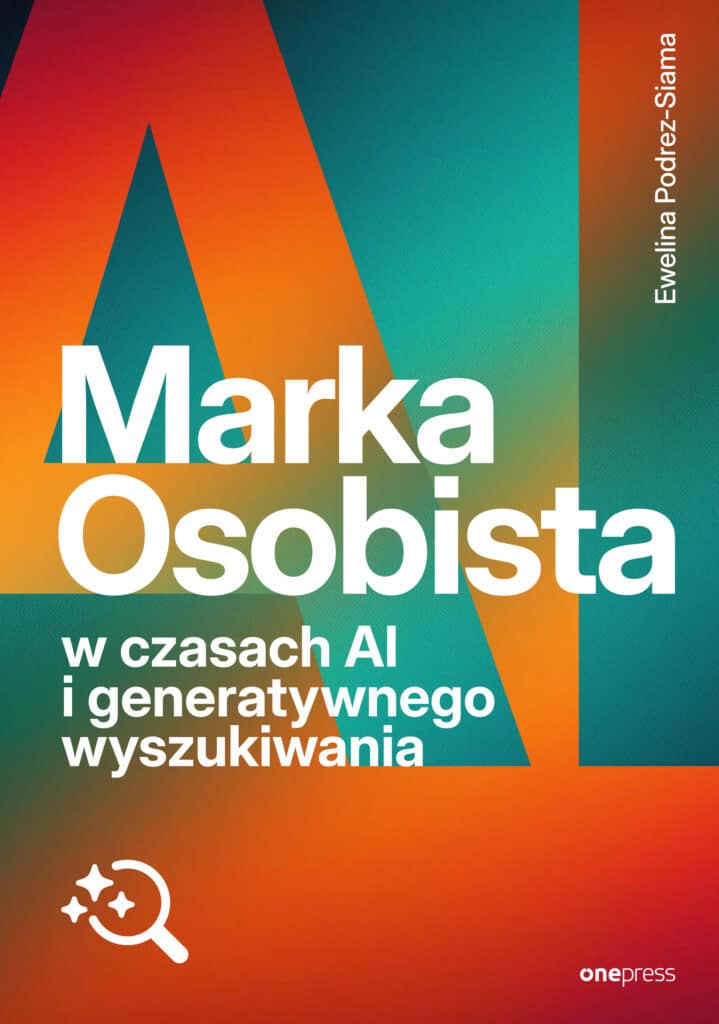
Book · currently in Polish
Marka osobista w czasach AI i generatywnego wyszukiwania
Authority triangulation is one chapter of a bigger story: how I rebuilt my entity step by step – with the Knowledge Graph data, the before-and-after, and the full playbook. Published in Polish by Onepress/Helion in June 2026. The mechanisms, in English, live on this blog.
About the book →