
As of October 17, 2026 · Bing Webmaster Tools data for July–September 2026
On October 13 Microsoft added a new tab to the AI Performance report in Bing Webmaster Tools: Topics Portfolio. It shows which topics your site appears in within AI answers. It also suggests “opportunities”: queries where AI cites other sites and not yours. Sounds like a ready-made content plan, right?
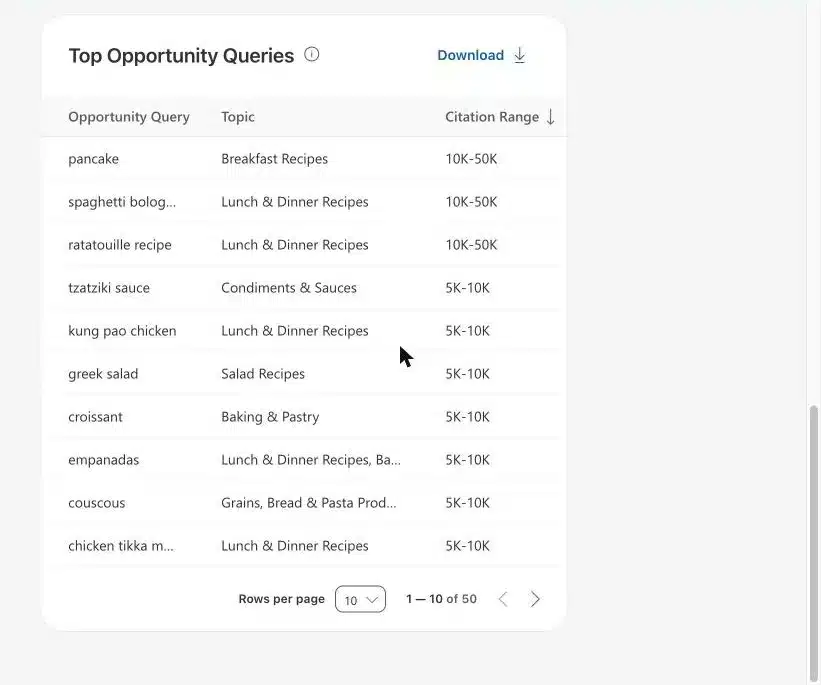
I opened the report for podrez.pl. The top opportunity: visual search. Second: bing visual search. My Polish guide to Madeira got Vietnam, my Bornholm guide got Greece in five languages, and my keto blog got pancakes. Before deciding it was just my bad luck, I checked all 51 sites I have in Bing Webmaster Tools.
In short
Topics Portfolio groups the queries where Copilot and Microsoft’s partners cite your site into topics. It also shows how big each topic is and lists “opportunities” (Top Opportunity Queries).
Across the 21 sites that have the view I found 972 opportunity queries. Four were in Polish, the language most of these sites are written in. The lists are tailored to each site, but not to its language or market. A large clothing store got 23 shoe models it doesn’t carry.
The value lies elsewhere: in your own queries within each topic, and in the topics that are missing.
My Bing Webmaster Tools account holds 51 sites. In July–September 2026, 33 had citations and 21 had topics. Share of citations in topics: median for those 21.
What is Topics Portfolio in Bing Webmaster Tools?
It’s a new beta view in the AI Performance report, announced by Microsoft on October 13, 2026. AI Performance shows when your site is cited in AI-generated answers in Microsoft Copilot, AI summaries in Bing and selected partners. I covered the report in my post on grounding queries. In June Microsoft added Intents, Topics, Citation Share and Compare.
Topics Portfolio goes one step further. Instead of single queries it shows whole topic areas: their size, how crowded they are, and the queries where others win. In the interface the tab is called Topic Portfolio, without the “s”.
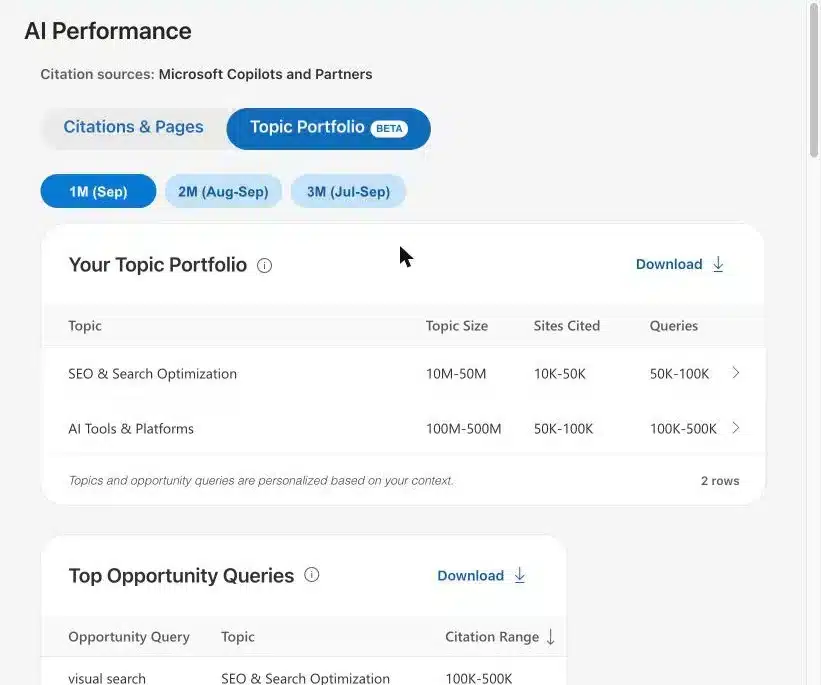
How to read the columns
| Column | What it means | What to watch out for |
|---|---|---|
| Topic | a cluster of related grounding queries where your site appears | labels are AI-generated and can miss: a clothing store gets a Military & Defense topic |
| Topic Size | approximate total citations across all sites in the topic | citations, not searches or people |
| Sites Cited | approximate number of sites cited, i.e. how crowded it is | you don’t learn who they are |
| Queries | approximate number of distinct queries in the topic | a range, not a number |
| Top Opportunity Queries | queries where other sites are cited and yours isn’t | citation ranges are global, and competitor brands can show up |
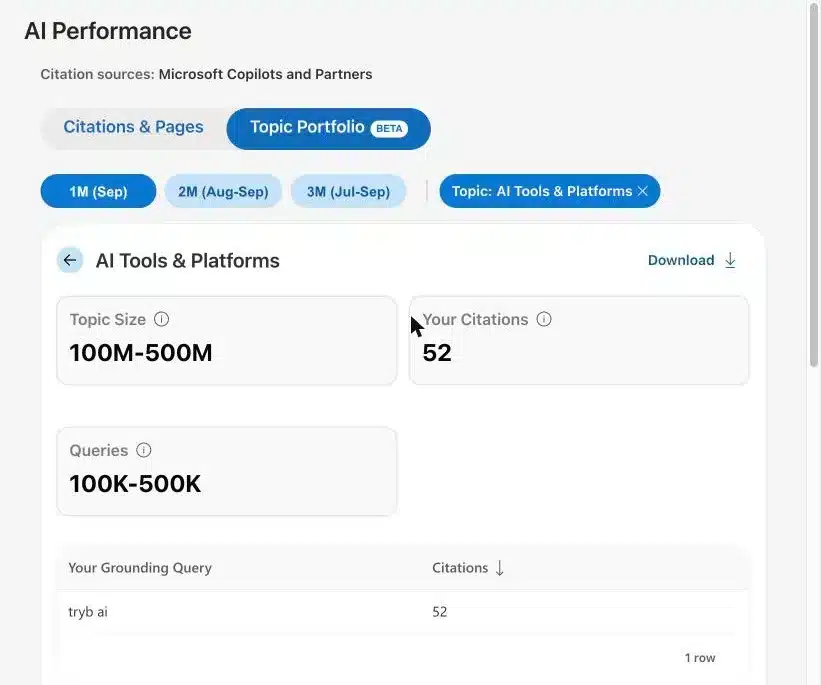
Click a topic and you get three figures (Topic Size, Your Citations, Queries) and two tables. The first lists your own queries in that topic (Your Grounding Queries, up to 10 rows). The second lists the opportunities in that topic (up to 50). The data covers one, two or three full months.
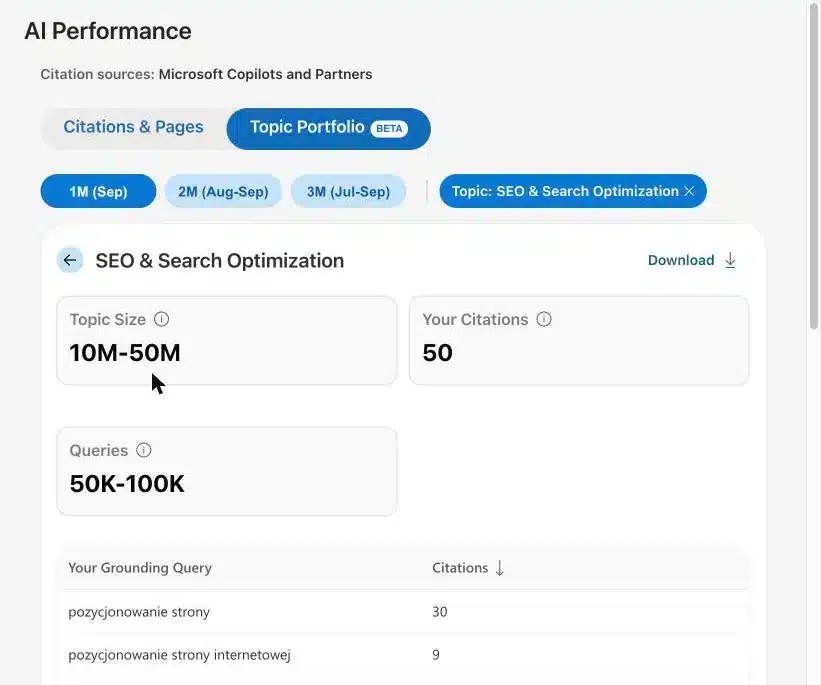
Microsoft asks you to treat these numbers “as directional signals for planning, not as a precise ledger”.
Direction, not bookkeeping. I took that to heart… and counted anyway.
How I checked it
My Bing Webmaster Tools account holds 51 sites: my own and my clients’. All of them target Polish users; client data is anonymised, only the industry is shown. For each site I pulled citations, the topic list, 50 opportunity queries and the detail of every topic. The main window is July–September 2026, with September alone for comparison.
21 sites with topics
From a portal for seniors with almost 80,000 citations to a branding agency with 107. The rest of this post is based on them.
12 with citations but no topics
Including a legal foundation (753 citations), a travel site, a cake shop and a beauty salon.
18 with no citations
Mostly sites added to the account on the day of the analysis. Bing may not have had data for them yet.
How many citations does it take to get topics? I don’t know, and the data won’t tell you either: the smallest site with topics had 107 citations, the largest one without them had 753. Microsoft only mentions “sufficient data”.
All 21 sites with topics in one table
| Site | Citations Jul–Sep | Opportunities in the site’s language | Citations in topics | Topics Jul–Sep / Sep |
|---|---|---|---|---|
| portal for seniors | 79,860 | 0 of 50 | 61% | 29 / 21 |
| legal portal | 63,734 | 0 of 50 | 25% | 16 / 15 |
| language school | 49,381 | 0 of 50 | 30% | 36 / 26 |
| psychotherapy practice | 40,957 | 0 of 50 +3 ambiguous (“terapia…”) | 47% | 39 / 34 |
| driving school | 40,100 | 0 of 50 | 34% | 29 / 20 |
| ms-fox.pl (my keto blog) | 20,938 | 0 of 50 | 54% | 16 / 15 |
| clothing store | 19,078 | 0 of 50 | 27% | 24 / 17 |
| diet blog | 14,032 | 0 of 50 +5 ambiguous (“dieta…”) | 25% | 12 / 10 |
| payment provider | 13,361 | 0 of 50 | 47% | 7 / 4 |
| podrez.pl | 9,168 | 0 of 50 | 5% | 4 / 2 |
| ERP implementation partner | 6,599 | 0 of 50 | 58% | 17 / 12 |
| tiling tools store (France) | 4,148 | 6 of 50 in French | 33% | 5 / 4 |
| consulting firm | 3,892 | 0 of 50 | 27% | 7 / 5 |
| bornholm-online.pl | 3,027 | 0 of 50 | 38% | 8 / 7 |
| law firm | 2,823 | 0 of 50 | 18% | 9 / 7 |
| decorations wholesaler | 2,232 | 0 of 50 | 15% | 9 / 8 |
| madera-online.pl | 1,446 | 2 of 50 | 27% | 4 / 3 |
| restaurant | 1,317 | 0 of 5 | 0% | 1 / 0 |
| travel agency | 972 | 1 of 50 | 28% | 4 / 2 |
| print shop | 212 | 1 of 50 | 34% | 1 / 1 |
| branding agency | 107 | 0 of 17 | 23% | 1 / 1 |
Citations in topics is the sum of “Your Citations” across all topic details divided by all citations in the Citations & Pages tab for the same period. A query assigned to two topics counts twice, so treat it as an upper bound.
Finding 1: the opportunities barely speak Polish
Of 972 opportunity queries, four were clearly Polish: “trip to Dubai”, “the most beautiful places in the world”, “the most interesting places in the world” and “printing service”, all in Polish. Ten more were queries like “dieta keto”, “terapia emdr” or “geriatria” that could just as well be Spanish, Italian, German or Portuguese. The rest? About 80% English, followed by Spanish, Dutch, Korean, French, Chinese…
* Including queries that are just the name of a place or a dish. ** 4 queries clearly in Polish, 10 ambiguous (e.g. “dieta keto”, “terapia emdr”, “geriatria”). Language assigned by hand, query by query.
podrez.pl → visual search
Top of the list: “visual search” and “bing visual search”, 1M–5M citations each over three months. Then 16 queries in Korean, such as “geo 최적화”.
madera-online.pl → Vietnam
Mui Ne and Quy Nhon in Vietnam, Laos, a Dubai tour. Not a word about Madeira; the closest it got was the Azores.
bornholm-online.pl → Greece
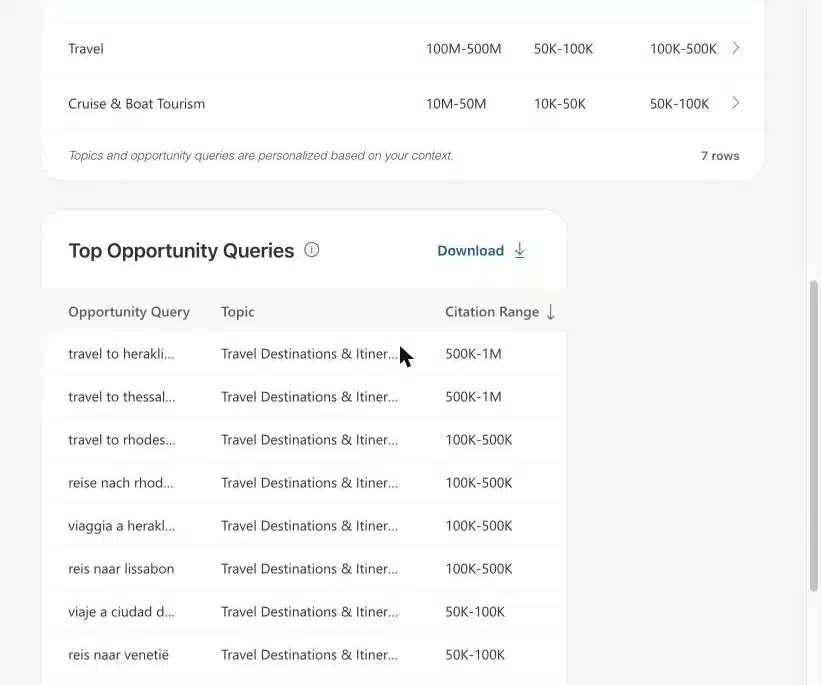
Trips to Heraklion, Thessaloniki and Rhodes in English, German, Italian, Turkish and Romanian. Bornholm: zero; the closest was Copenhagen, in Dutch.
ms-fox.pl → pancakes
Pancake, pico de gallo, beef stroganoff, tiramisu. All in English, none of it keto.
driving school → Spanish road signs
Provisional driving licence, señales de tránsito, traffic rules in India, plus the French “permis am”.
Kraków café → Boston
Best brunch spots in Boston. A bit of a trek for breakfast.
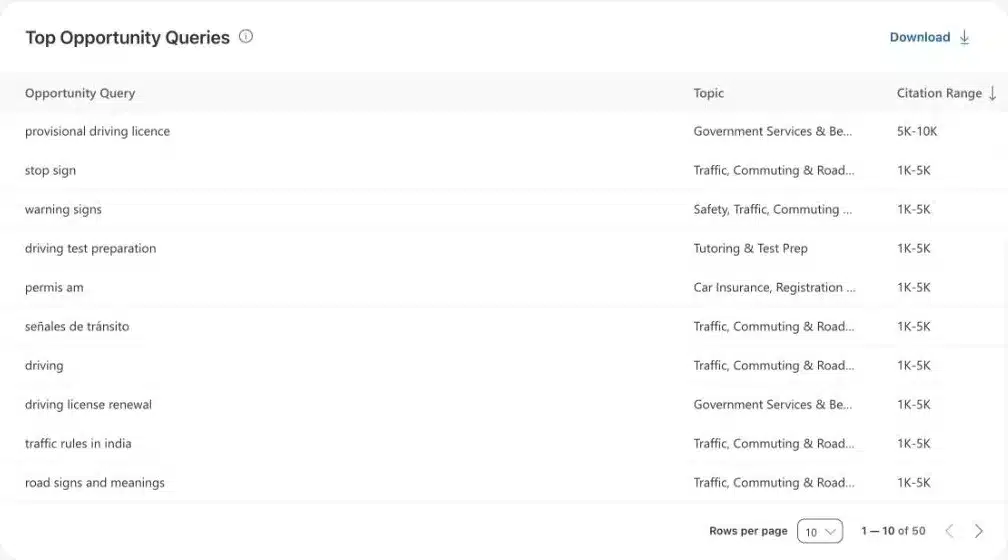
Control group
Maybe it’s just Polish having bad luck? I checked a French store selling tiling tools. Its own queries are in French, led by “outillage carrelage” with 810 citations.
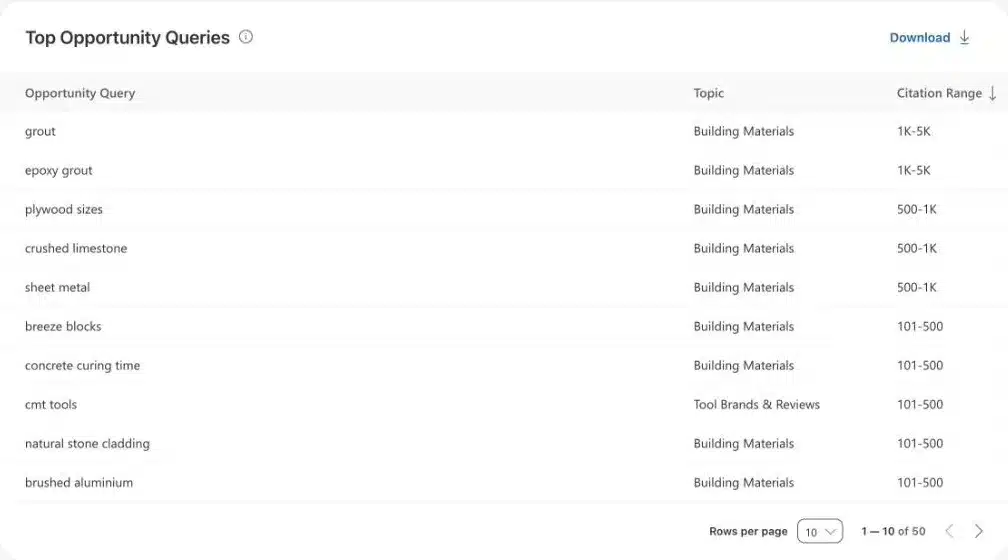
Among its opportunities, 6 of 50 are in French. At the top: grout and epoxy grout, the French store’s own product, just in English. So it isn’t about Polish. It’s about any language other than English.
Finding 2: the list is tailored to your site, not to your market
For a moment I assumed the opportunities were simply a global list per topic, identical for everyone. Microsoft says otherwise: “Everything in this view is personalized to your site”. So I tested that too.
35 topics appear on at least two sites, giving 75 pairs of lists for the same topic. 60 pairs share not a single query. The median overlap is 0%; the highest, 12%, is between two recipe blogs in Breakfast Recipes.
My two travel blogs show it best. Both have Travel Destinations & Itineraries. Madeira got Vietnam and Laos there, Bornholm got Greece. Shared queries: zero.
Personalised: yes. Filtered by language and market: no.
The list is picked for your site, not for the language you write in or the people you write for.
A large e-commerce store: almost half the opportunities are shoes it doesn’t sell
The most interesting case came from a clothing store selling premium brands. It’s a large e-commerce business with eight language versions, from Polish to Romanian: 19,000 citations in three months and 24 topics.
Who earns the citations? The Italian version
The store’s home page is in Polish. Yet Polish queries bring in only 10% of citations within topics. The largest share, 42%, comes from Italian. The biggest topic, Fashion Styling Tips, rests almost entirely on one question about casual outfits for women, asked in five variants. That’s the footprint of a single article on the Italian version of the store.
| Query language | Share of citations | Example |
|---|---|---|
| Italian | 42% | casual outfits for women, five variants of one question |
| English | 27% | “dress code” (845 citations) |
| brand names on offer | 14% | premium brands the store sells |
| Polish | 10% | “[store name] returns” (368), women’s running shoes |
| German, Czech, French, Slovak | 7% | ski clothing, autumn 2026 colours, what to wear on a plane |
70 own queries across 24 topics, July–September 2026. Language assigned by hand.
Two things follow from this table. First, you can see which language versions actually earn AI visibility. Second, AI answers questions about returns by citing the store’s own page. If the returns information is out of date, Copilot will repeat it to customers.
And the opportunities? New Balance, Asics, Puma…
All in English. The store has an English version, so this time it isn’t an entirely foreign market. The assortment is another story. I compared the list with the brand directory on the store’s site: 23 of 50 opportunities are shoe models the store doesn’t carry. New Balance six times, Asics six, Nike four, Puma three, plus Jordan, Crocs, Crime London and Adidas Predator. The store does sell Nike and Adidas, but only other lines: Nike Swim, Adidas Golf and Adidas by Stella McCartney. Only one query matched its range: waterproof On Cloud 6.
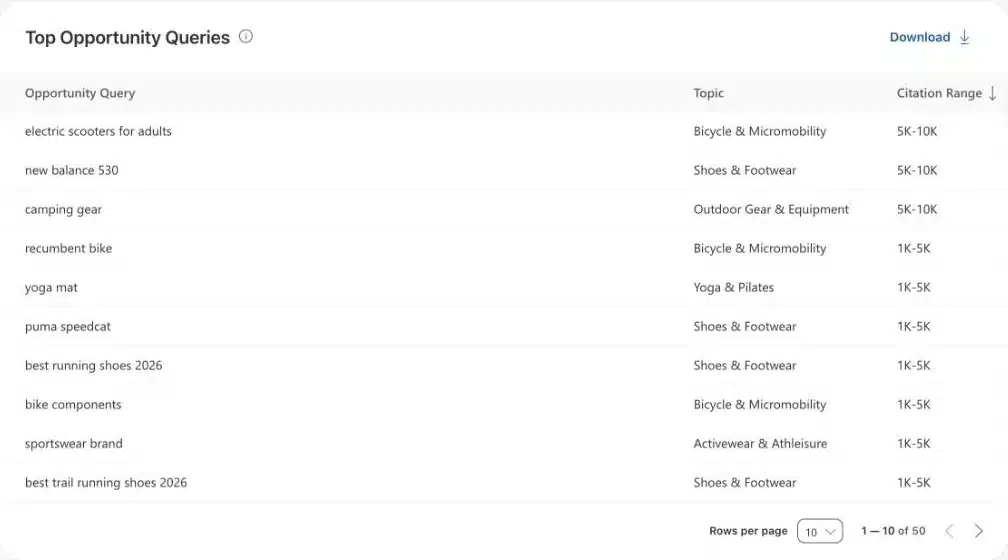
And it isn’t random noise. Among the full 50-query lists, this one turned out to be the most stable: 36 of 50 queries appear in both September and the full quarter. Very consistent noise.
If you run a store, filter the opportunities through your brand list or product feed.
Only what survives belongs in a content plan. Here that’s a dozen or so general topics: best running shoes for 2026, trail shoes, hiking clothes, quarter-zips.
Four things the report doesn’t tell you
- 1
Topics cover only a slice of citations
The median is 28%, ranging from 0% to 61%. On podrez.pl it’s just 5%. Nothing here replaces the Citations & Pages tab.
- 2
The list changes every month
The median overlap between the September list and the full-quarter list is 48%. On the Madeira guide 1 of 6 queries repeated; on the clothing store, 36 of 50.
- 3
The biggest numbers are templates
The 14 opportunities in the 1M–5M citation range are mostly templated travel queries in many languages: “travel to heraklion greece”, “quebec kanada besuchen”, “visitar delhi”. They look generated by a product feature rather than typed by people. That’s my hypothesis.
- 4
Topics can come from left field
The clothing store has Military & Defense because of a fashion brand named after the Italian Air Force, and Air Travel because of a question about what to wear on a plane. Topic labels are AI-generated.
Relevance: from “almost” to “completely off”
On topic, but in English
ERP implementation partner: crm, sap erp. Psychotherapy practice: emdr therapy, dbt therapy. Consulting firm: kpi meaning, gantt chart.
In the topic, wrong market
Driving school: provisional driving licence, traffic rules in India. Portal for seniors: reverse mortgage. Law firm: constructive dismissal.
Completely off
Madeira: Vietnam. Bornholm: Greece. Keto blog: pancakes. Kraków café: brunch in Boston. podrez.pl: visual search.
The first group can be useful, because it hints at what the industry talks about globally. But it’s research material, not a list of queries to target.
Where the real value is: your own queries
The most useful part is the Your Grounding Queries table in each topic: your own queries, grouped by Microsoft. A few examples from the sample:
| Site | Query (translated) | Citations | What it tells me |
|---|---|---|---|
| psychotherapy practice | “Machiavellianism” | 1,760 | AI cites the explanations of terms, not the practice’s services |
| ms-fox.pl | “zucchini pasta” | 1,255 | the blog’s strongest recipe, and the query doesn’t even mention keto |
| legal portal | “building law act 2026” | 915 | up-to-date legislation attracts citations |
| bornholm-online.pl | “destination: Ystad” | 490 | looks like a template from a travel feature, not a human question |
| madera-online.pl | “simplifica madeira” | 293 | the hiking-trail ticket system is what AI links to my blog |
| consulting firm | “phlegmatic” | 197 | its strongest query is a personality type, not consulting |
| law firm | “unpaid invoice” | 163 | real-life questions from business owners, good material for expert content |
| decorations wholesaler | “goods for festivals” | 134 | AI links the wholesaler to a specific use case |
| podrez.pl | “pozycjonowanie” (SEO) | 122 | the SEO topic is mine; the AI topic holds just “tryb ai” (AI Mode) for now |
Most-cited own queries within topics, July–September 2026. Queries were in Polish; translated here.
What’s missing says just as much. On ms-fox.pl my own queries are full of keto: “keto dinner” (664 citations), its reversed word order (597), “keto cake” (291). The topics, though, are generic recipe categories such as Lunch & Dinner, Baking & Pastry and Salad Recipes. Keto doesn’t appear in a single opportunity. Caesar salad does. The same salad in Polish, “sałatka cezar”, earns me 939 citations. In English it’s an “opportunity”.
In the system’s eyes ms-fox.pl is a recipe blog, and keto is just an adjective. That’s worth comparing with how the brand wants to be described.
How I use it in client work
- 1Pull the three-month window
Export both views: topics and opportunities. One month is too short, because the list can change halfway.
- 2Filter out other languages and markets
Usually a handful of queries survives, sometimes none. For a store, I also filter by the brand list.
- 3Read your own queries in every topic
They show what AI associates the site with and which language versions earn citations.
- 4Compare topics with the offer
A missing topic can matter more than a long list of opportunities.
- 5Cross-check with other data
Search Console, other tools and a fixed set of prompts. Bing is one perspective, and Copilot isn’t the whole AI market.
Want this analysis for your brand?
I’ll check what AI associates your site with, in Bing and beyond.
Frequently asked questions about Topics Portfolio
Is Topics Portfolio available for every site?
No. Microsoft shows it when there is sufficient data. In my sample 21 of 33 sites with citations had topics. The smallest had 107 citations in three months, while a legal foundation with 753 citations had none.
Does Topics Portfolio include ChatGPT data?
No. The report lists its sources as “Microsoft Copilots and Partners”: Copilot, AI summaries in Bing and selected partner integrations. ChatGPT, Gemini or Google AI Overviews have to be measured separately.
Can I filter opportunities by language or country?
Not in the interface. Export the list (Download button) and filter it yourself. For a store, add a filter for the brands you sell.
Are the opportunities the same for every site in a topic?
No. Across 75 pairs of lists for the same topic, the median overlap is 0%. The lists are tailored to the site, just without regard to its language or market.
What does Citation Range mean?
An approximate number of citations other sites received for that query across Microsoft’s whole ecosystem, not in your country. The ranges are wide, so use them to compare orders of magnitude, not to track change.
Query language: automatic detection plus manual review. List similarity: Jaccard index. Clothing store brand directory checked on October 17, 2026.
Microsoft, Introducing Topics Portfolio (Beta) in AI Performance, October 13, 2026. Client data anonymised.
