

Originally published in Polish: 3 October 2025 · Updated: 1 November 2026 · English translation: 1 November 2026
The SEO world has changed beyond recognition. Not long ago, search engine optimization mostly meant stuffing keywords into content, and today that tactic falls far short. The algorithm no longer matches words to words. It understands meaning, context and what you’re really looking for.
In this article
why keywords alone no longer cut it, and how to recognize user intent,
how the context of a query changes results, and what an entity is,
how we got from Hummingbird, BERT and MUM to AI Overviews and AI Mode. And what that changes in how you write.
Workshop recording
This article is a write-up of my SEO workshop at semKRK #23 BIG in Kraków in June 2025, expanded with a chapter from my book on brands in the age of AI. The first part is about entities, context and intent, the second about how the search engine learned to understand language. Participants rated the workshop 5/5. The recording is in Polish.
I can run a workshop like this for your team too: instead of examples from semKRK, we then work on your own keywords. Here’s how I work on AI search visibility.
Why keywords alone are no longer enough
A few years ago, SEO rested on a simple assumption: find a few good keywords and repeat them like a mantra across your pages.
What it looked like in 2005
That’s when I built my first websites. The search algorithm worked like a card index: it matched a word in the query to a word on the page. Whoever had the phrase in the title, heading, URL and often enough in the text, won. Whoever had more links, won even more often. Searching for a dentist, you got a list of pages with identical content that differed only in the name of the city.
Google had to react. Not out of pure concern for users, but because it was starting to drown in its own system: bad results mean people stop searching or go to a competitor. It was pragmatism, not idealism, but the effect was the same. The search engine had to learn to recognize what people were really looking for, not just which words they used.
Choosing the right phrases still matters, but today it’s only the tip of the iceberg. Algorithms judge the quality and usefulness of content, its context and the searcher’s intent. A page packed with repeated keywords but without real value doesn’t stand a chance of ranking high.
If your content is expert and tailored to the reader’s needs, you have a much better chance of ranking high than with keyword stuffing alone.
In practice I recommend a holistic approach: first focus on what you want to say and how to help the user, and only then think about which keywords to use. Paradoxically, by writing for the user (and not for robots), you do SEO a favor too.
Tip
Go through your most important pages and posts. Do they deliver real value? Do they answer customers’ questions and solve their problems? If not, it’s time for a refresh. On my own blogs I regularly update older articles, adding new information and cutting the fluff. That investment really pays off.
Search intent: SEO starts with purpose
If words alone don’t decide, what plays first fiddle? Search intent, the reason someone types a given query. Only by matching content to what the reader expects do you stand a chance of winning their attention, and the algorithm’s favor.
The main types of intent
Informational
The user is looking for information, a definition, knowledge. E.g. “how to make homemade pasta”, “what is page indexing”.
Navigational
They’re looking for a specific brand or site, e.g. typing a company name instead of its URL.
Commercial
They weigh options, compare products and services, look for reviews and rankings. E.g. “best smartphones 2026”.
Transactional
They want to buy, sign up or book an appointment. E.g. “Italian restaurant Warsaw booking”.
Why does it matter? Because the content of a page should match the intent. If someone is looking for knowledge and lands on a product page with nothing but an offer, they’ll leave quickly. And the other way round: when they want to buy something “right now” and get a long blog article, they’ll be disappointed too.
How to recognize intent in the search results
| What you see in the results | Intent | What is likely to win |
|---|---|---|
| guides, definitions, videos, “People also ask” | informational | a detailed guide, ideally with video (e.g. “how to make pizza”) |
| product cards, shops, prices, Google Shopping | transactional | a shop or landing page with a clear CTA (e.g. “smartwatch XYZ price”) |
| rankings, “top 10”, reviews, comparisons | commercial | a thorough comparison with links to shops (e.g. “best gaming laptop 2026”) |
Google has already done part of the work of recognizing intent. Just look at the results.
Try it
Take 5 keywords you want to rank for. Search for them and analyze the results. Does your page fit? If not really, change your content strategy for that phrase. A mistake I often see: a dry category description in a shop (in the hope it will start ranking), while competitors have guides or roundups.
Query context: location, device, time and history
Personalized results are a fact. Google adjusts results not only to the words typed, but also to the setting you search in. Two people can type the same query and see different results. What does the search engine pay attention to?
- 1
Location
Google knows (e.g. from your IP or GPS) where you are. “Pet shop” in Warsaw means Warsaw shops, a map and Business Profiles. Working locally? Look after local SEO.
- 2
Device
Results on phones and desktops differ. On phones you more often see “tap to call” and carousels, and people more often ask by voice, in longer phrases.
- 3
Time
News results change dynamically, and “Christmas gift” in December is something else than in July. Keep evergreen content updated and publish seasonal content in demand windows.
- 4
Search history
The search engine learns you. I search for keto recipes, so after “chocolate cake” I get sugar-free versions higher up. You don’t necessarily.
What does that mean for you?
- local business → local SEO (phrases, links, listings, map),
- a mobile-friendly site is the baseline (mobile-first indexing is standard),
- update content, especially rankings and statistics,
- diversify channels: SEO, social media, newsletter; don’t rely on one algorithm.
Fun fact
To see less personalized results, check them in an incognito window or via a VPN. That helps when assessing rankings and intent.
Semantics, entities and NLP: Google understands meaning, not just words
Google used to match “letter by letter”. Today it uses semantic search, natural language processing (NLP) and entities to understand the meaning of queries and content.
Semantic search
The algorithm picks up context, purpose and connections between words. That way it can match a result that answers the question even if it doesn’t contain exactly the same phrases. Example: “weather in the capital of France”. Google understands the relation France → capital → Paris and shows the forecast for Paris. Or “height of the highest mountain in Poland”: the algorithm knows it’s about Rysy, even though the name never appeared.
Entities: from pages to meaning
There’s something that for years was invisible to most creators and business owners: Google doesn’t see the world in terms of web pages. It sees it in terms of entities.
An entity is a unit of meaning the algorithm can identify unambiguously: a person, a company, a place, a concept, a product, an event. Each has its own attributes and relationships with other entities. Together they form the Knowledge Graph.
An entity and its relationships in the knowledge graph. My own diagram.
What does it mean for SEO? When you write about SEO, entities appear naturally: Google, algorithm, PageRank, keywords, content, links. If your text covers the key entities and connects them logically, you signal completeness and substance. In a good article about the history of Apple, mentions of Steve Jobs, the iPhone or Tim Cook are expected. When they’re missing, the content may be seen as incomplete.
An entity has attributes
When Google sees the query “Robert Lewandowski”, it doesn’t look for a page with that name. It looks for the entity and checks its attributes: footballer, striker, Poland international, clubs, trophies. It knows this from thousands of connected sources.
Attributes change over time
Arnold Schwarzenegger is one entity whose attributes kept growing: bodybuilder, actor, governor of California. Google doesn’t delete old attributes, it updates the entity.
Your image online works the same way. If for years people associated you with being a “specialist”, and now you want to be a “strategist”, the algorithm won’t forget straight away. New attributes have to be visible enough to outweigh the old ones.
NLP and language understanding
NLP (Natural Language Processing) lets Google analyze syntax, recognize parts of speech, tell facts from opinions and understand synonyms (“car” = “automobile”, “value added tax” = “VAT”).
What does that mean for you?
- don’t rigidly repeat one form of a keyword,
- focus on the topic area, entities and a full explanation of the subject,
- use synonyms and different word forms, write naturally,
- answer specific questions (FAQs, question headings), because Google likes to show such fragments.
From BERT to AI Mode: the second part of the workshop
Entities, context and intent were the first half of the workshop. In the second, we went through how Google knows what you’re asking at all. And what it does with that knowledge today, when instead of a list of links it more and more often shows a ready answer. There was no single update after which everything changed. There was a series of steps, each moving the algorithm a little further from mechanical matching.
The key steps from matching words to understanding meaning. Source: “Marka osobista w czasach AI i generatywnego wyszukiwania”, table 1.1, my own diagram.
Hummingbird: the question matters more than the word
In 2013 Google rolled out Hummingbird rather quietly. Yet it was a fundamental breakthrough: for the first time the search engine began to treat a query as a question rather than a set of words to match. “Dentist Warsaw” is two words. “Where can I find a good dentist near central Warsaw?” is a question with intent, context and an expectation.
Natural-language queries keep growing. When it announced BERT in 2019, Google said about 15% of daily queries are ones it has never seen before. Today’s generative models are designed for exactly these questions.
BERT and MUM: Google learns to read
BERT (2019) understands the context of a word in both directions: what comes before it and after it. “A ticket from Warsaw to Berlin” and “a ticket from Berlin to Warsaw” use the same words, with a completely different meaning. Before BERT, prepositions like “from” and “to” could get lost. For SEO, the effect was very down to earth: separate pages for “what is SEO” and “SEO definition” stopped paying off, because Google sees the same question in both. One solid source beats five thin ones.
MUM (2021) went further. It understands text and images, was trained across 75 languages and can gather information from many sources into one answer. You won’t find a “MUM” button in search, because Google rolls it out piece by piece, but the direction was already clear: besides other pages, we also compete with an answer the search engine puts together itself.
AI Overviews and AI Mode
Google tested AI summaries from 2023 as the Search Generative Experience and launched them in the US in May 2024 as AI Overviews. In Poland, where I work, they’ve been available since March 2025, and AI Mode since 8 October 2025.
AI Overviews
They gather information from a few sources and give a quick answer above the results. And that’s where it ends.
AI Mode
It breaks the question into further ones (query fan-out), builds a detailed answer and lets you follow up in the context of the conversation. It’s no longer a search engine with an answer, but a conversation in which Google guides you through the topic.
Where do these answers get their content? From pages Google has in its index, selected by the same systems as regular results. In its documentation from 15 May 2026, Google describes AI features in search as part of SEO: there’s no separate tag or submission that lets a page into AI Overviews. What’s in that guide, and what’s missing, I took apart in my analysis of Google’s guide to generative AI search.
In practice
Search for “Who is [your first and last name]?” and check what Google says about you in AI Overviews, if it says anything at all. Do the same in AI Mode. Is what the user sees what you want to say about yourself? Is it even you?
What does it mean for content?
With informational questions, some clicks stay in the summary. That’s why, beyond position, what matters is whether your page is a cited source in it. At the workshop we turned this into writing rules:
- 1
One idea per paragraph
Each paragraph stands on its own when taken out of the text. BLUF, the answer upfront, helps here.
- 2
Headings as questions
They sound the way people type them into search.
- 3
Side questions
AI Mode breaks one query into several smaller ones (query fan-out), so answer those too.
- 4
Something of your own
Data, a test, an example from your own project. That can’t be rewritten from the first page of results.
In Senuto’s 2024 report on AI Overviews I put it this way: “AI won’t destroy SEO, but it will force it to grow up.” I stand by that. The foundations stayed the same: indexing, links, reputation. What has shifted is the center of gravity, toward a consistent brand and content that can’t be rewritten from the first page of results. The algorithm is getting better at telling someone who knows something from someone who only writes about it.
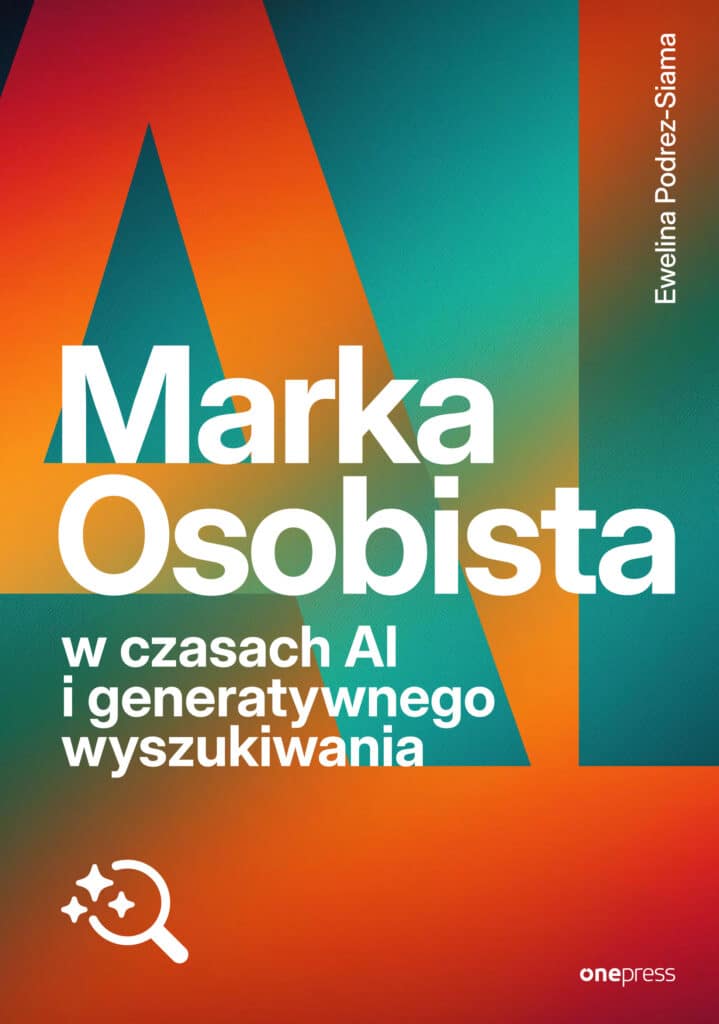
Book · currently in Polish
Marka osobista w czasach AI i generatywnego wyszukiwania
To understand what algorithms want from you, you first need to understand how they learned it. That’s where my book starts. Published in Polish by Onepress/Helion in June 2026.
About the book →3 questions to finish
- 1
Does Google understand who you are?
Or does it only know you exist? Search for your name and check which attributes it assigns to you.
- 2
What intent does someone looking for a person like you have?
Not which words they use, but what problem they want to solve and what situation they’re in. Does your brand answer that question?
- 3
Do you have proof or just claims?
Think of three things that confirm your authority. Not on your own site, but elsewhere: in other people’s statements, citations, roundups.
One thing stays the same: the user comes first. If you deliver the best possible value, then whether a person or an AI algorithm judges you, you have a chance to come out ahead.
How your site does in AI answers you can check in the “Generative AI” report in Search Console and in AI Performance in Bing Webmaster Tools. Prefer to go through it with someone, on your own brand? Here’s how I work on AI search visibility.
Read next



Questions about entities, context and intent
What is an entity in SEO?
A unit of meaning that a search engine can identify unambiguously: a person, a company, a place, a product, a concept or an event. An entity has attributes and relationships with other entities, and together they form the Knowledge Graph.
What is search intent?
The reason someone types a query. Most often you’ll see informational, navigational, commercial and transactional intent. The easiest way to recognize it is to look at what Google shows in the results for the query.
Do keywords still matter?
Yes, but as a starting point. Keyword research helps you understand how people ask. Content, however, is judged by whether it matches intent and covers the topic, not by how often a phrase repeats.
How are AI Overviews different from AI Mode?
AI Overviews give a quick summary from a few sources above the results. AI Mode breaks the question into sub-queries, builds a longer answer and lets you ask follow-ups in the context of the conversation.
How can I check what Google knows about my brand?
Search for “Who is [first and last name]?” or your company name and see what AI Overviews and AI Mode show. Compare it with what you want to say about yourself. And check whether it’s even you.
Sources
Google, Introducing the Knowledge Graph: things, not strings (2012). Google, Understanding searches better than ever before (BERT, 2019). Google, MUM: A new AI milestone for understanding information (2021).
Google Search Central, guide to optimizing for generative AI features (15 May 2026). Senuto, AI Overviews report (2024).
Ewelina Podrez-Siama, Marka osobista w czasach AI i generatywnego wyszukiwania (in Polish), Onepress 2026, chapter 1. SEO workshop at semKRK #23 BIG (June 2025).
