

Search used to end with a list of links. Increasingly, it ends with an answer – generated by a language model in AI Overviews, AI Mode, ChatGPT or Perplexity, with the sources reduced to footnotes. In this world, the term GEO (Generative Engine Optimization) has grown fast – and with it, a debate about whether it replaces SEO. I argued in October 2025 that it doesn’t: it’s an evolution, not a revolution. In May 2026, Google settled a large part of that debate. More on that below.
What is GEO (Generative Engine Optimization)?
GEO (Generative Engine Optimization) is a strategy for raising the odds that your content becomes a source in answers generated by LLMs and AI search – with a citation and a link back where possible.
The unit of the game changes. It’s no longer only about classic positions in the SERP, but about whether your content becomes part of a model-generated answer: whether it gets cited, linked, and recognized as a credible source of knowledge at all.
GEO doesn’t kill SEO, GEO hides an expanded definition of SEO inside it. SEO taught us how to talk to Google’s algorithm. GEO teaches us how to talk to a language model that reads, connects, and paraphrases our content. Classic SEO remains the foundation: without correct crawling, indexing, linking, and coherent semantics, an LLM has no chance of noticing you in the first place.
| SEO | GEO | |
|---|---|---|
| Goal | a high position among the links | becoming a cited source in a generated answer |
| Unit of optimization | the page and the domain | also the fragment: a paragraph, a definition, a table – the chunk the system evaluates on its own |
| Where it plays out | Google, Bing | AI Overviews, AI Mode, ChatGPT, Perplexity, Copilot, Gemini, Claude |
| Success metric | rankings, clicks, organic traffic | citations and citation share – measurable since 2026 in first-party reports (Bing AI Performance, the Generative AI report in Search Console) |
| The relationship | not rivals – SEO is the foundation GEO stands on; within Google’s ecosystem, GEO officially is SEO (see below) | |
Google weighed in – partially
When I first published this article in October 2025, the GEO-vs-SEO debate was running on speculation. Since May 15, 2026, it runs on documentation: Google published an official guide to optimizing for generative AI features, and in it a sentence that ends a certain chapter of the discussion: “From Google Search’s perspective, optimizing for generative AI search is optimizing for the search experience, and thus still SEO.”
Within Google’s ecosystem – AI Overviews and AI Mode – the term “GEO” is now officially redundant. It’s SEO with new display surfaces. Which practically begs for my favorite meme:

Partially, though – because Google speaks only for itself. ChatGPT, Perplexity and Claude retrieve data differently, from different sources, by different criteria. Outside Google’s ecosystem, GEO as a distinct set of practices keeps its justification: the training layer, the retrieval layer and the citation criteria of each system are its own. One term, two territories – inside Google it’s a synonym for SEO, outside it still names real, separate work.
The mechanisms we now know by name
In October 2025 I wrote that an LLM “reads, connects and paraphrases” your content. That was the honest level of precision available then. Nine months later, the key mechanisms have names, documentation – and reports you can open today.
RAG (Retrieval-Augmented Generation). The model doesn’t answer purely from training memory – it first retrieves current sources and builds the answer on top of them. Google confirmed in its guide that RAG in Search runs on the same ranking systems and the same index as classic results. What that means for your brand’s presence in AI answers, I described in Your Brand in LLMs: What RAG Knows About You.
Query fan-out. One user question gets decomposed into a series of parallel sub-queries – Google described the mechanism officially at the launch of AI Mode and then wrote it into its documentation. Every section of your article is a separate candidate in a separate selection. That changes how content earns citations: depth of topic coverage intersects more fan-out paths.
Grounding queries. Since February 2026, Bing Webmaster Tools shows – for free – the actual phrases AI systems used to retrieve and cite your content, along with Citation Share. I walked through the report, with data from four of my own sites, in the grounding queries guide. Spoiler: the phrases look suspiciously like good old keywords.
Cost of retrieval. The price a system pays to extract your answer from a document. The higher it is, the lower the odds your fragment gets picked. The single strongest lever for lowering it is BLUF – Bottom Line Up Front: the answer first, the justification after, at the level of the article, the section and the paragraph.
None of this replaces the foundations. All of it sharpens where the foundations point.
How to prepare content for LLMs – the framework
Since we know GEO is not a new monster but the next incarnation of SEO, let’s get concrete. What does “optimizing content for LLMs” mean? Start with the most important thing: LLMs don’t think. They connect facts they find in credible contexts. Your job is to build that context – logical, coherent, and readable for a human and a model alike.
1. Topical authority: full contexts, not single articles
Content has to form complete topical contexts. Query fan-out gives this old rule a new engine: a topic covered from many angles intersects many sub-query paths at once, where a lone article catches one at best. Depth wins over breadth of keywords – with one boundary Google drew explicitly: producing separate variants of the same content for every possible query violates the scaled content abuse policy. Fan-out rewards coverage, not multiplication.
2. Write in the language of entities, not phrases
Brand SEO becomes Brand GEO: build a brand the model recognizes as a source of knowledge. A model doesn’t match strings – it resolves entities: who you are, what you’re connected to, whether independent sources confirm it. If your name is still just a string of characters to the systems, start with From String to Entity, then give the algorithms structured evidence in Wikidata.
3. Structured data and machine readability
The LLM “reads” structure. Make sure your data is logical, marked up with schema, and easy to process. One clarification the Google guide added: there is no special schema.org markup required for AI Overviews – structured data is not an admission ticket. It remains what it always was: semantic hygiene that reduces ambiguity about who you are, what you publish, and how it connects. Person and Organization with sameAs aren’t “AI markup”. They’re how you stop being a guess.
4. AI-trust signals: the layer Google’s guide stays silent about
Systems assembling an answer look for sources they can safely attribute: consistent identity across the web, citations in credible contexts, an author with a verifiable history. Curiously, Google’s generative AI guide never mentions E-E-A-T, entities or authors – not once. I don’t read that silence as “trust stopped mattering”. I read it as “we won’t hand you the checklist”. The reputation layer sits in the Search Quality Rater Guidelines and in how an established entity’s trust carries over to new projects – documented, just not in this particular document.
5. Test and measure – the era of guessing is over
This point I’ve rewritten completely since the first edition, because the landscape changed the most here. In October 2025, measuring AI visibility meant third-party tools and manual spot checks. Today the measurement stack has three floors:
- First-party reports: AI Performance in Bing Webmaster Tools (grounding queries, citations, Citation Share – free, live) and the Generative AI report in Google Search Console (impressions in generative features, rolling out gradually since June 2026).
- Manual testing: ask ChatGPT, Perplexity, Gemini and Claude the questions your audience asks – on a clean account, without conversation history. Check whether you appear, in what context, and whether the model gets the facts right.
- Third-party monitoring: tools like Chatbeat, Ahrefs Brand Radar or Senuto’s AI modules for tracking at scale – useful, with one caveat: aggregate scores can shift when the tool’s prompt mix shifts, so read them against the raw run-level data.
The practical starting point hasn’t changed: export what the machines already associate with you, find the gaps between what you write about yourself and what actually gets cited, and work from there.
The conversation the world is having with AI
GEO forces a more mature version of SEO – one that doesn’t fight for the click, but for the citation. It doesn’t focus solely on Google’s algorithm, but on how your knowledge resonates across the web: how often it’s recalled, understood and interpreted by language models.
Because in the end, real optimization is no longer just visibility in Google. It’s participation in the conversation the world is having with AI. And in that conversation, it’s not about shouting the loudest. It’s about being remembered as the one who had something true to say.
Need a second pair of eyes on your strategy, an audit, or simply a conversation about what could work better? Here’s how I work and how to reach me.
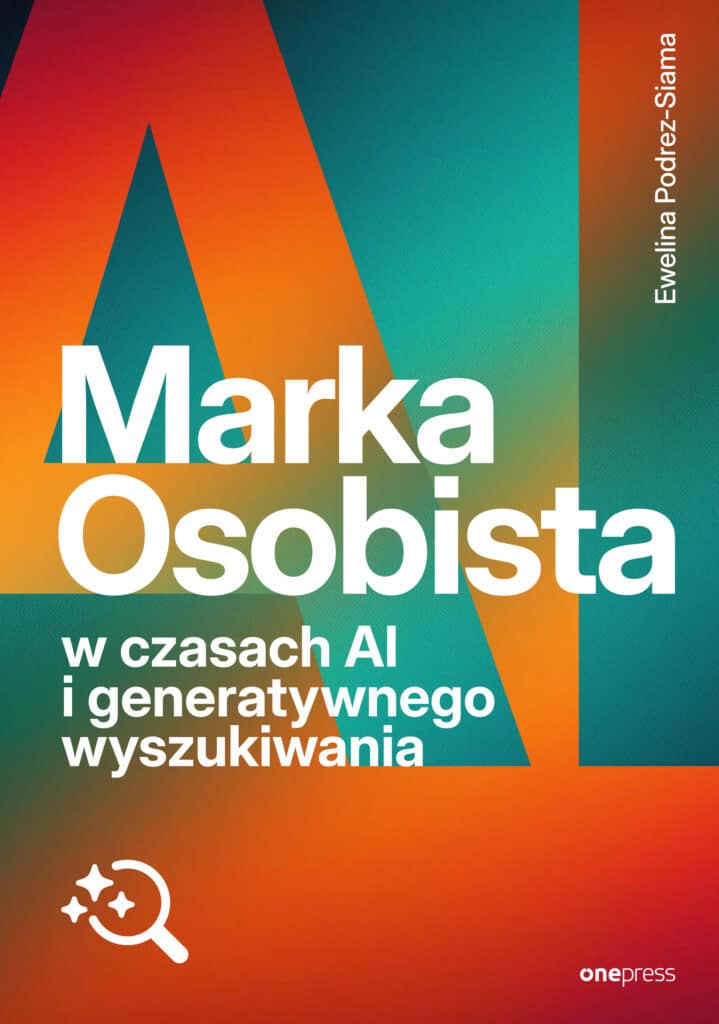
Book · currently in Polish
Marka osobista w czasach AI i generatywnego wyszukiwania
GEO, entities, patents, the Google leak, Trust Halo — and what to do with all of it in practice. Published in Polish by Onepress/Helion in June 2026. The mechanisms, in English, live on this blog.
About the book →
The distinction between “inside Google it is SEO, outside Google it is real separate work” is the part most guides still miss, and it matches how we build. One caveat on the Ahrefs schema finding though: schema is still worth shipping as entity hygiene (Organization and Person with sameAs so you stop being a guess), just not as a citation lever. Where we see movement is the extraction-cost side you describe: answer-first sections with checkable numbers, an llms.txt and crawler policy that actually let AI bots read the site, and asking the real buyer questions against ChatGPT, Perplexity and Gemini before touching a single template. The audit usually shows the gap is crawlability or missing facts, not markup. (I build sites and agents with this layer baked in at neu Intelligence)