

Open ChatGPT on a clean account and type your own name. If the answer is technically correct and completely useless – no context, no role, no reason to recommend you to anyone – you’re not alone. I spent years in exactly that spot. Without knowing it.
What an LLM is – and why it doesn’t “search” for you
A language model doesn’t search for answers when you ask a question. It recalls them from what it absorbed during training – and that difference is the source of more bad branding decisions than any algorithm update I’ve seen since 2009.
ChatGPT, Claude, Gemini – each was trained on an enormous body of content: articles, books, websites, forums, databases. That training runs up to a specific point in time, the cutoff date. Past it, the model stops learning – unless it gets retrained or gains access to the live web. If you were present in the training data, the model can recall you. If you weren’t, there is nothing to recall you from.
What this means for your brand
The baseline answers LLMs generate about you are shaped by what was written online early enough and widely enough to enter the model’s training data. Everything you do later shows up in default answers only after the next training update. In practice, the effect often becomes visible only when a newer model ships.
RAG: when a language model reaches for fresh data
This is where RAG comes in – Retrieval-Augmented Generation. Picture a student before an exam. She can rely on what she memorized, or she can be allowed to bring her notes. RAG is the notes: instead of answering purely from memory, the model searches external sources first – websites, databases, documents – and only then constructs the answer. It doesn’t copy them. It reads, processes, and builds its own synthesis.
What is RAG? RAG, or Retrieval-Augmented Generation, is a technique that lets a language model pull current data from external sources instead of answering solely from training memory. The model receives a question, searches the web or a database, retrieves fragments, and builds the answer on top of them.
Google AI Overviews, Perplexity, Copilot – all of them run on some variant of RAG, though each system has a slightly different architecture and weighs signals differently when picking sources.
A user asks a question, the system searches the web, retrieves fragments from the most credible and semantically related sources, and assembles the answer from them.
Which brings us to the question this entire article hangs on: how does the system know which sources are “most credible”?
Remember this — LLM vs AI Overviews
Language model (ChatGPT, Claude, Gemini in chat)
Answers from training data — like a graduate with a fixed graduation date. It won’t reach for new data unless you enable web search, Deep Research, or explicitly ask it to check current information.
AI Overviews (Google)
The system pulls current pages from the search index, processes them, and only then does the model generate the answer. It doesn’t recall — it searches. Content freshness, indexability, and organic visibility matter here directly.
The most common mistake I see with clients: treating AI Overviews like a plain language model with no search access. These are two different mechanisms — and two different visibility strategies.
How RAG picks its sources – and what that has to do with your brand
The source-selection mechanism rests on several signals at once. Simplifying: the system looks for content that is topically relevant (semantically similar), comes from sources it considers credible, and stays consistent with other signals about the same subject across the web.
When someone asks about an expert in a given field, the system looks for pages, articles, and mentions that connect a specific name with a specific topic. And then it starts counting: how many times does this name appear in this context? In which sources – trade media, reviews, interviews? Who cites this person as a reference point? Are the signals consistent over time, or did they all appear a month ago?
Think of someone in your industry who gets clients through referrals but has zero presence online. A restaurant with no reviews in sources RAG treats as credible. A name that never shows up in trade articles, that nobody cites as a reference. To the system – that person doesn’t exist.
The same fate awaits content mass-generated by AI with no verifiable author behind it. RAG will find it. But it has no reason to trust it more than dozens of other sources saying the same thing – no entity, no history, no external confirmation. For an algorithm looking for something it can safely attribute, that content exists but contributes almost nothing to a credibility assessment.
An expert with a dense network of digital traces holds something entirely different: a newsletter linked from industry sites, interviews in the media, citations in other authors’ articles, a LinkedIn profile with hundreds of reactions. Each of these is a signal RAG can retrieve, verify, and fold into an answer.
The system doesn’t judge who’s the better specialist. It judges who left enough verifiable traces.
The three states of brand presence in AI answers
Now that you know how RAG picks its sources, we can name what happens to a brand inside that process. In my work I observe three states. I call them absent, diffuse, and coherent – not marketing categories or officially sanctioned terms, but operational descriptions of what the algorithm returns, and why.
State 1: the absent brand
An absent brand is one for which the system cannot find enough consistent signals linking a specific name to a specific topic – so it returns nothing. Or returns someone else.
This is not the algorithm “rejecting” a brand. It simply doesn’t see one. Absence from credible sources equals nonexistence – regardless of how many years someone has worked in the field.
Telltale signs:
- no mentions in external sources
- your own website as the only place the name appears
- nobody citing you
State 2: the diffuse brand
A diffuse brand appears in the data, but its signals point in different directions – so the model knows the name and cannot classify it. This state is more insidious than absence, because everything looks fine on the surface. The name is out there. But the contexts vary, no dominant association emerges, and the model can’t say with confidence: “this person is an expert in X.” It either skips the name, mentions it with hedged context, or – worst of all – mentions it in the wrong context.
Telltale signs:
- an online presence… scattered across topics
- different contexts in different sources
- the algorithm “knows” the name but can’t pin it down
From my own experience
I spent several years in state two – and for a long time I couldn’t see it, because after all, “I was online.” The problem ran deeper than a blurry message.
For years I published under the pen name Ms. Fox – a food blog, three cookbooks that became bestsellers in Poland, a completely separate identity. To an algorithm, that wasn’t “one person with two passions.” Those were two unrelated beings that happened to share a surname in the meta tags.
When I finally typed my own name into LLMs, I got an answer that was technically correct and entirely useless. No context, no role, no reason to recommend me to anyone in any specific situation.
State 3: the coherent brand
A coherent brand is backed by a dense, consistent network of signals connecting one name to one topic – across many independent sources, sustained over time, in the company of other strong entities. In this state, RAG can recommend a brand with confidence, because it holds enough verifiable data for the answer to be safe.
Telltale signs:
- citations in industry media
- topical consistency over time
- connections to other strong entities
- structured data confirming identity
- presence in Wikidata with filled-in attributes
From my own experience
After a few months of deliberately cleaning up my entity (you can inspect the result yourself in my Wikidata item), the answers language models gave about me started to change.
Not because I wrote more or got louder on social media. Because the network of signals became dense and consistent enough for the algorithm to recommend me without risking an error. That is the difference between being in the data and being recognizable in the data.
Read also: Wikidata Step by Step. How to enter the database Google trains language models on
One thing matters here: these states are not permanent. You can build state three and slide back to state two through neglect. You can sit in state one for years and reach state three within months of deliberate work.
From diagnosis to action
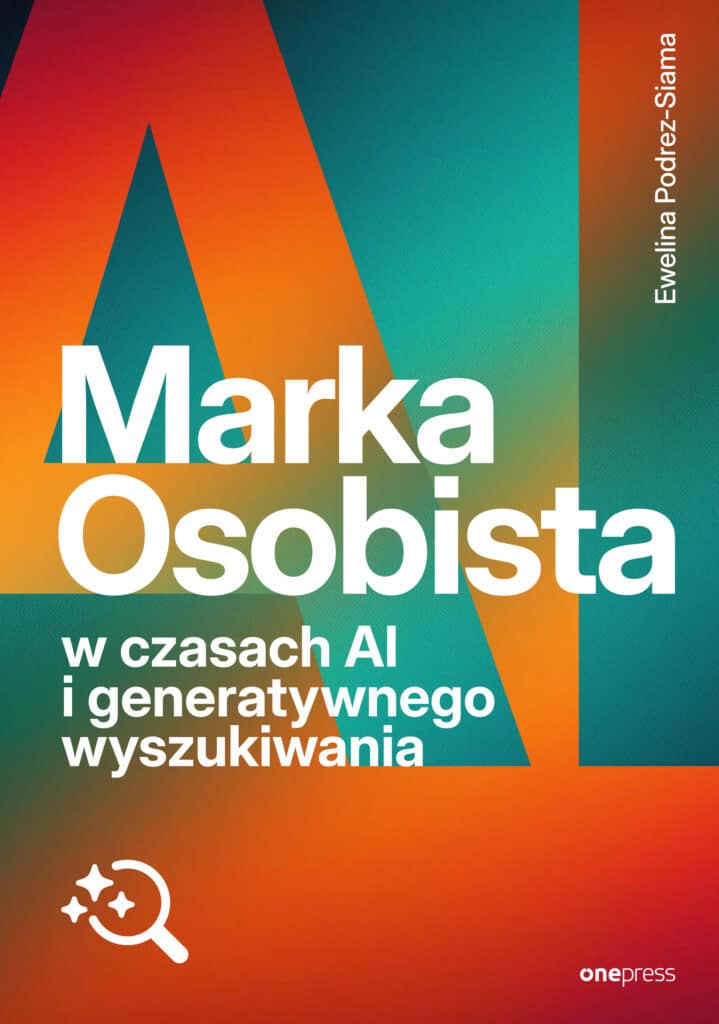
You now know which state your brand is in. What to do about it – step by step, with a list of concrete signals to build and my own case study of cleaning up an entity from scratch – is in my book Marka osobista w czasach AI i generatywnego wyszukiwania (Onepress/Helion, 2026). It’s currently available in Polish. If diagnosis was step one, that’s where the rest of the map lives – and if you don’t read Polish, this blog is where I publish the mechanisms in English, piece by piece.
Out now · currently in Polish
Marka osobista w czasach AI i generatywnego wyszukiwania
Personal branding for the AI search era. Diagnosis is step one — the step-by-step build, with case studies and the full list of signals, is in the book.
About the book →What has to exist online for an algorithm to recall you
I’m deliberately not writing “what you have to do” – that suggests a one-off action. I’m writing “what has to exist,” because this is a state you build over time.
Citations in high-credibility sources
RAG doesn’t treat all sources equally. An article in a trade publication carries different weight than a post on your own blog. An interview in a national newspaper – different weight than a LinkedIn post. Wikipedia and Wikidata – different weight than a company website.
This hierarchy isn’t arbitrary. It’s a product of how language models were trained – on data in which certain sources appeared more often as reference points for other sources. Pages cited by other pages carry higher credibility in the model’s eyes. And one mention in a major publication can be worth more to RAG than a dozen articles on your own site.
You will find similar logic in Google’s public guidelines for Search Quality Raters. They are written for the people who rate search results, so they say nothing about the models themselves – but they point the same way.
The guidelines treat an “about me” page as the starting point and send raters to independent sources for the evidence. I show what that looks like in practice using Wikidata as an example.
See Google’s guidelines (PDF)Topical consistency over time
RAG doesn’t only check whether signals exist. It checks whether they’re consistent, and for how long. A name that has appeared in the context of SEO for three straight years – in articles, interviews, citations, structured data – sends a far stronger topical signal than a name that spent three years writing about everything and discovered SEO a month ago.
This is exactly the mechanism that makes switching industries algorithmically expensive. The model carries a history in its training data that you cannot overwrite with one good article. You can only layer new signals on top of it, gradually, until the new context becomes dominant.
From my own experience
How long does it take? It depends on the density of your existing signals and the pace of building new ones. In my case – from deliberately cleaning up my entity to the first visible changes in AI Overviews – it took a few weeks. In ChatGPT or Gemini, at least a few months.
Contextual density – whose company you appear in
The algorithm doesn’t judge you in isolation. It judges you through the lens of who and what you appear next to. If your name regularly co-occurs with the names of other recognized experts – you inherit part of their credibility. If it appears alongside institutions the algorithm already knows and trusts – those connections strengthen your entity.
That’s why the places you show up in matter beyond image. They matter algorithmically. An interview at an industry conference covered by the media is a different signal than the same interview published on your own blog. A co-authored article with an established expert is a different signal than a solo piece – the entity context is different.
Structured data and Wikidata – the language RAG reads natively
Structured data and Wikidata aren’t SEO tools in the classic sense. They’re entry points into the RAG conversation – places where the algorithm can retrieve structured, verifiable information about you and fold it into an answer with a high level of confidence.
What is Wikidata? Wikidata is an open knowledge base run by the Wikimedia Foundation — the same organization behind Wikipedia. Where Wikipedia is an encyclopedia written by people for people, Wikidata is designed primarily with machines in mind.
Read also: Wikidata Step by Step. How to enter the database Google trains language models on
The data follows a strict structure: every person, company, or concept gets a unique identifier and a set of properties — profession, workplace, publications, connections to other entities. No ambiguity, no prose to interpret. Structured facts only.
How do we know Google takes this data seriously?
In the patent the model gets a kind of external memory and reaches into it alongside what it learned in training. In the experiments that memory was built from Wikidata knowledge triples. Does that mean your entry goes straight into answers? The patent does not say so.
See the patent on Google PatentsIf your entity isn’t in Wikidata (or is, but with empty attributes), the algorithm has fewer anchor points. If it’s well filled in – the algorithm holds a ready, verifiable answer to the question: who is this person, and why can they be trusted on this topic?
Structured data on your own site follows the same logic. A page without it can still be a RAG source — but the algorithm has to infer the context from prose on its own. A page with a well-implemented Person schema tells the algorithm directly: this person, this topic, these connections, these confirmations. That’s the difference between a source RAG has to interpret and a source that speaks a language RAG reads natively.
Check which state your brand is in
The signals that get you into the AI conversation form an ecosystem you build over time — one that either lets the algorithm recommend you with confidence, or makes it prefer not to take the risk.
A simple exercise for today: open ChatGPT or Gemini on a fresh account, with no conversation history. Type your first and last name. What comes back? Absent, diffuse, or coherent — that diagnosis matters more than your Google rankings. Your position in search tells you where you are today. What a language model says about you tells you where you’ll be when generative search becomes the default way people look for information.
And that’s the moment you decide whether you’re building a brand algorithms understand — or only one that you understand.

About the author
The three states aren’t theory. I’ve been through all of them with my own name — absent, diffuse, and finally coherent enough that the models started answering. SEO strategist since 2009, founder of Fox Strategy, author. See what a deliberately built entity looks like from the inside.
Meet the author →