

Trust Halo is the transfer of an established entity’s trust to a new domain connected to it. A documented case study: madera-online.pl launched with no backlink campaign and reached 4,000+ clicks in seven weeks – plus the leaked Google attributes that explain why.
In psychology there’s a cognitive bias called the halo effect: one salient trait colors the assessment of all the others. Edward Thorndike discovered it in 1920 while studying how military officers rated their soldiers – a high mark for bearing automatically pulled up the marks for intelligence and character. Algorithms do exactly the same thing. And that’s why a new domain doesn’t always start from zero.
Thorndike described his findings in A Constant Error in Psychological Ratings, showing how the halo of one trait illuminated the whole. For several years now I’ve been watching a similar mechanism at work in algorithms. With one difference: instead of military officers, we’re dealing with entities.
Trust Halo
A new domain doesn’t always start from zero. Sometimes it starts from your reputation.
Where does the name Trust Halo come from?
Thorndike’s halo effect says: one salient trait influences the assessment of unrelated traits. In marketing the mechanism is well described – a positive experience with one product of a brand makes you trust the next one without testing it.
“Halo effect” already functions in SEO vocabulary, but in a different sense: as the influence of a strong brand on CTR and user behavior.
What I haven’t found in the industry literature is a consistent definition of the phenomenon where trust travels from an entity to a domain. That’s why in this text, as in my book Marka osobista w czasach AI i generatywnego wyszukiwania (Personal branding in the age of AI and generative search – in Polish), I give it the working name Trust Halo.
The Trust Halo mechanism is documented
Trust Halo as a name may be a working term, but the mechanism itself isn’t speculation – it’s documented in several places at once.
The Content Warehouse API leak (May 2024)
In May 2024, internal Google Search API documentation leaked – over 14,000 attributes describing what Google collects when evaluating pages.
Three attributes tie directly into the Trust Halo mechanism:
- authorReputationScore – a reputation score for the author as an entity, measured independently of the domain.
- isAuthor – Google verifies whether the entity mentioned on a page is also the author of that page. This is an entity-centric signal, not a domain-centric one.
- hostAge – domain age, used to handle the sandbox. A new domain means more caution – but that caution flows from a domain attribute, not from the author’s entity. Two different vectors.
The Google Sandbox
Sandbox is the unofficial name for a phenomenon SEOs have observed for years: for a few weeks to a few months, new domains rank far below what their content quality and link profile would suggest. Google has never officially confirmed the mechanism exists — but the 2024 Content Warehouse API leak revealed the hostAge attribute: domain age as one of the measured signals. It’s the closest thing to official sandbox documentation the industry has ever had.
The key takeaway
Google stores the author’s reputation as an entity separately from the domain. If a new domain is connected to an entity with a strong reputation — the algorithm has something to hold on to.
Search Quality Rater Guidelines (Google, 2025)
In the guidelines for Search Quality Raters, Trust is described as “the most important member of the E-E-A-T family” – the central element around which the other three merely play a supporting role.

But that’s not the most important fragment for someone building a personal brand. More important is how Search Quality Raters are told to carry out that assessment.
The guidelines name three sources a rater should use when evaluating a page’s E-E-A-T:
- What the creator says about themselves – the “About” page, the author profile.
- What others say about the creator – independent reviews, articles, mentions in credible sources.
- What’s visible on the page itself – and whether the content backs up the declared expertise.
A significant part of assessing a page’s quality is an assessment of the author – independent of the page itself, verified in external sources.
The guidelines go further and describe outright which signals build a creator’s positive reputation: education and certifications for specialists, reviews from other experts in the field, citations, a publication history.
And for online creators – mentions in biographical articles, comments from other creators in their field, a history of regular presence on recognized sites.
The document even gives a concrete example of a page rated High Quality: “the author of this blog post has become known as an expert on parenting issues and is a regular contributor to this and other websites”. The creator’s positive reputation is listed there as one of the main reasons for the page’s high rating.
Trust Halo in the language of Google’s guidelines
A Search Quality Rater assessing a new page reaches for information about the author beyond that page. If the author’s entity has a history — citations, mentions, a consistent presence across the web — that history works in favor of every new page the author creates.
And the reverse: the guidelines state directly that “a lack of reputation about people who post personal content is neither a positive nor a negative sign” — no history isn’t a minus, but it grants no advantage either.
A new domain from an author with no entity history starts from zero. A new domain from an author with a history — doesn’t.
And this brings us back to the heart of Trust Halo: trust, as Google’s guidelines understand it, is not a one-time certificate. It’s a pattern of predictability over time – whether the entity behind the content has a history that is consistent, verifiable, and free of signals the algorithm reads as self-serving.
The heart of Trust Halo
Trust isn’t built on the new page. It’s built on the entity that creates it.
Case study
I’ve been experiencing the effect I call Trust Halo empirically for a good few years now – whenever very specific conditions are met, namely: when the site is backed by a person or organization recognizable in the given topic.
Most often I saw it with clients who, after years of SEO work, launched a new, topically related domain. This time I’m watching it happen to myself – which means I can share the data without compromise.
The context of madera-online.pl
On February 13, 2026 I launched madera-online.pl. A test project, but one close to my heart – a blog about Madeira (in Polish), written from my own trips, photos and trails. New domain, new geographic niche, zero history on the web.
To judge whether we can speak of a Trust Halo in the travel topic, one piece of context matters. Reading this blog, you mostly know me from SEO and business – but in parallel I’ve been building my own projects:
- the food blog ms-fox.pl (my first, very significant connection to the culinary space, including world cuisines),
- and the travel blog bornholm-online.pl (a niche travel site, developed since 2024).
So entering the Madeira topic, I wasn’t a “fresh face” as an entity – the algorithms already saw me as the author of popular cookbooks on world cuisines and the author of a site in a niche travel topic (one quite limited in scaling potential, precisely because of that niche).
Below, a simplified model of my ecosystem:
| Domain | Role in the ecosystem | Role in the Trust Halo | What it means in practice |
|---|---|---|---|
| ms-fox.plsince 2016 | Foundation source of the entity |
Generator | History since 2016, books with ISBNs, hundreds of indexed recipes. This is where the algorithms’ trust in the name was born. |
| podrez.plsince 2008 / since 2023 | Entity integration identity consolidation |
Transfer | The domain has existed since 2008, but in its meaningful form — a personal site with deliberate entity-building — since 2023. It merges “Ewelina of the recipes” and “Ewelina of SEO” into one entity. |
| bornholm-online.plsince 2024 | Niche expansion new topic |
Synergy | Inherits authority from both previous domains. Noticeably faster indexing than a launch with no entity history. |
| madera-online.plsince 2026 | New project rapid growth |
Synergy | Pure Trust Halo effect — no sandbox, impressions from day one, media citations after 5 weeks. |
Steps taken and the first results
- Late in the evening of February 13 I publish the new domain, its structure a twin of bornholm-online.pl,
- madera-online.pl is a “fresh” domain – no prior history, no links,
- the blog holds about 10 posts, a large share of them about Madeiran cuisine (plugging into the culinary side of my entity),
- every post carries my own photos, credited with my full name (stock photos are a last resort for me),
- from day one I sign as Ewelina Podrez-Siama, and I connect the domain to every other domain of mine through Person structured data and the sameAs property.
From the start, I signal clearly to the algorithms that the same person stands behind the site.
And this is where the “Trust Halo” kicks in:
- Indexing is immediate (also a product of good optimization, the Instant Indexing API, Search Console setup and a submitted sitemap.xml).
- Impressions and clicks appear the very next day.
The results after seven weeks
Around 7 weeks after launching the site, I have:
- over 4,000 clicks,
- over 90,000 impressions,
- an average position of 5.8 (whole period; 4.7 in the last 7 days),
- a CTR of 4.3% (whole period; 4.6% in the last 7 days).
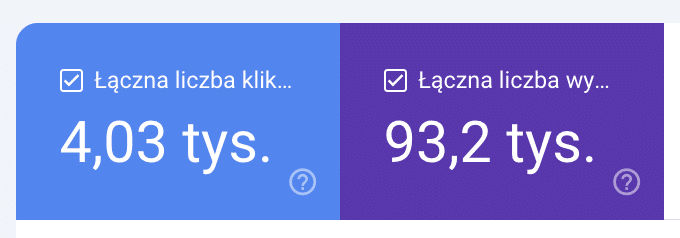
Curiously, the first impressions and clicks showed up on February 13 itself (the site went live around 9 PM Madeira time, about 10 PM in Poland). That is not a phenomenon I observe often.
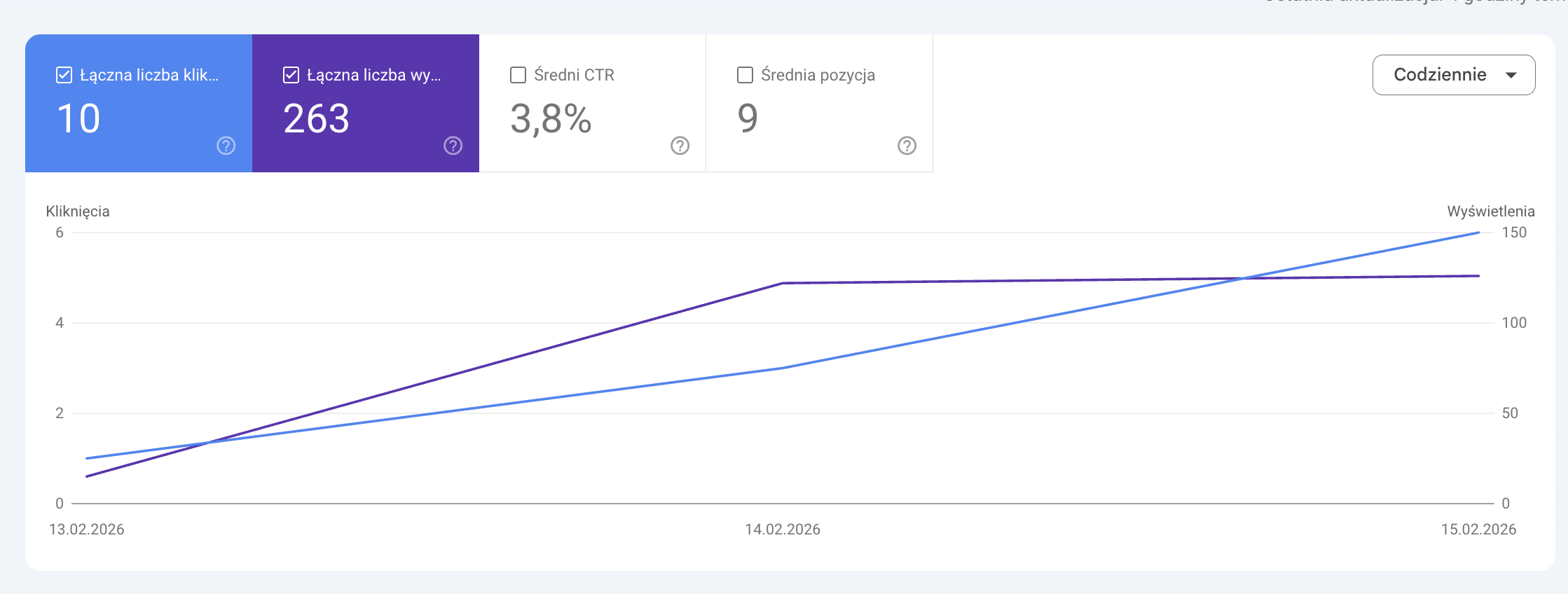
This is also the point where Senuto and Ahrefs can’t even keep up with the fresh domain’s real visibility (it happens – it was the same years ago, when I showed conference audiences a food blog collecting thousands of clicks at near-zero visibility in monitoring tools). A domain that, by sandbox logic, should be fighting for every signal from zero, for weeks or maybe months.
Update: October 2026. From launch on 13 February to 6 October 2026, madera-online.pl collected 28,760 clicks and about 1.04 million impressions in Google (Search Console, whole domain). By month: 5,046 clicks in July, 5,659 in August, 6,131 in September. In the second half of September, though, weekly clicks fell from about 1,600 to just under 1,300, so growth has stalled for now. CTR and average position are weaker than at the start (2.6% and 7.3 in September, against 4.3% and 5.8 after 7 weeks), but there are more than three times as many impressions as in March.
Links still do not explain the growth. Ahrefs (read on 9 October 2026) sees 395 referring domains, but once you remove the ones it flags as spam and the link farms on .shop domains, 6 are left. The valuable ones are still my own domains plus, since 23 September, Wikidata (nofollow). The same Ahrefs data shows 118 citations of the site in AI answers, most of them in AI Overviews.
Why so fast?
It wasn’t:
- technical optimization alone – it was good, tested on the twin project, but not exceptional (with WordPress’s usual limitations).
- weak competition – travel agencies and tourism portals are demanding company. Besides, the twin project bornholm-online.pl, in a much smaller niche with lower competition, took many weeks to get going.
Behind the new domain stood an “old” entity: consistent structured data across four domains, citations, books (with ISBNs) from recognizable publishers.
The new domain entered the knowledge graph not as an anonymous new being, but as the next project of an entity the algorithm already trusted.
This is the effect I call Trust Halo. Trust in a Person entity transfers to that entity’s new projects – not through internal links, not through redirects, but through the entity’s consistency across the entire web.
Citations in AI Overviews
Two weeks after launch, the first citations appeared in Google’s AI Overviews, followed by ChatGPT after three weeks. The result holds to this day, though competitors have started copying the solutions I implemented.
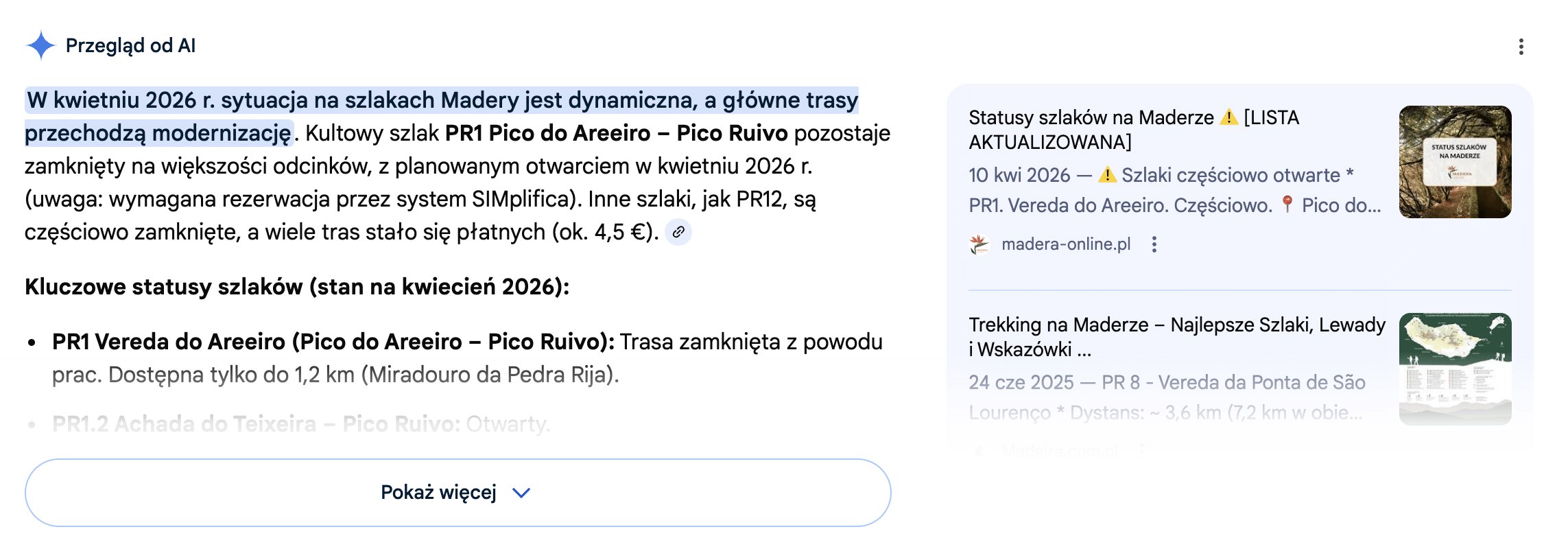
For the phrase “madera statusy szlaków” (Madeira trail statuses) and many related ones, the site appeared as one of the sources recommended by Google AI Overviews and AI Mode – next to Madeira’s official portals (IFCN, Visit Madeira). A reminder: we’re talking about a site a few weeks old.

An important reservation
Citations in AI Overviews and LLMs are not a direct Trust Halo effect. LLMs don’t actively verify the author — they can associate a domain with a person if the association was strong enough in the training data. Google and the LLMs arrived at a similar conclusion — by different roads.
The link profile, or “where’s the catch?”
At this growth rate for a new domain, every SEO’s warning light comes on: “Where are the powerful news-site links that pushed the domain through the newness filter?“ A fair question – I’d ask it myself.
The answer, however, is short: there are no such links.
Analyzing the link profile, we see a situation that old-school SEO would call textbook “unfavorable”:
- only three referring domains: all of the traffic was built without any broad link building,
- a closed domain ecosystem: every link comes from domains belonging to my own entity,
- a potential “conflict of interest”: per the Search Quality Rater guidelines, links from yourself (from your own ecosystem) can be treated with limited trust, as they aren’t an independent recommendation.
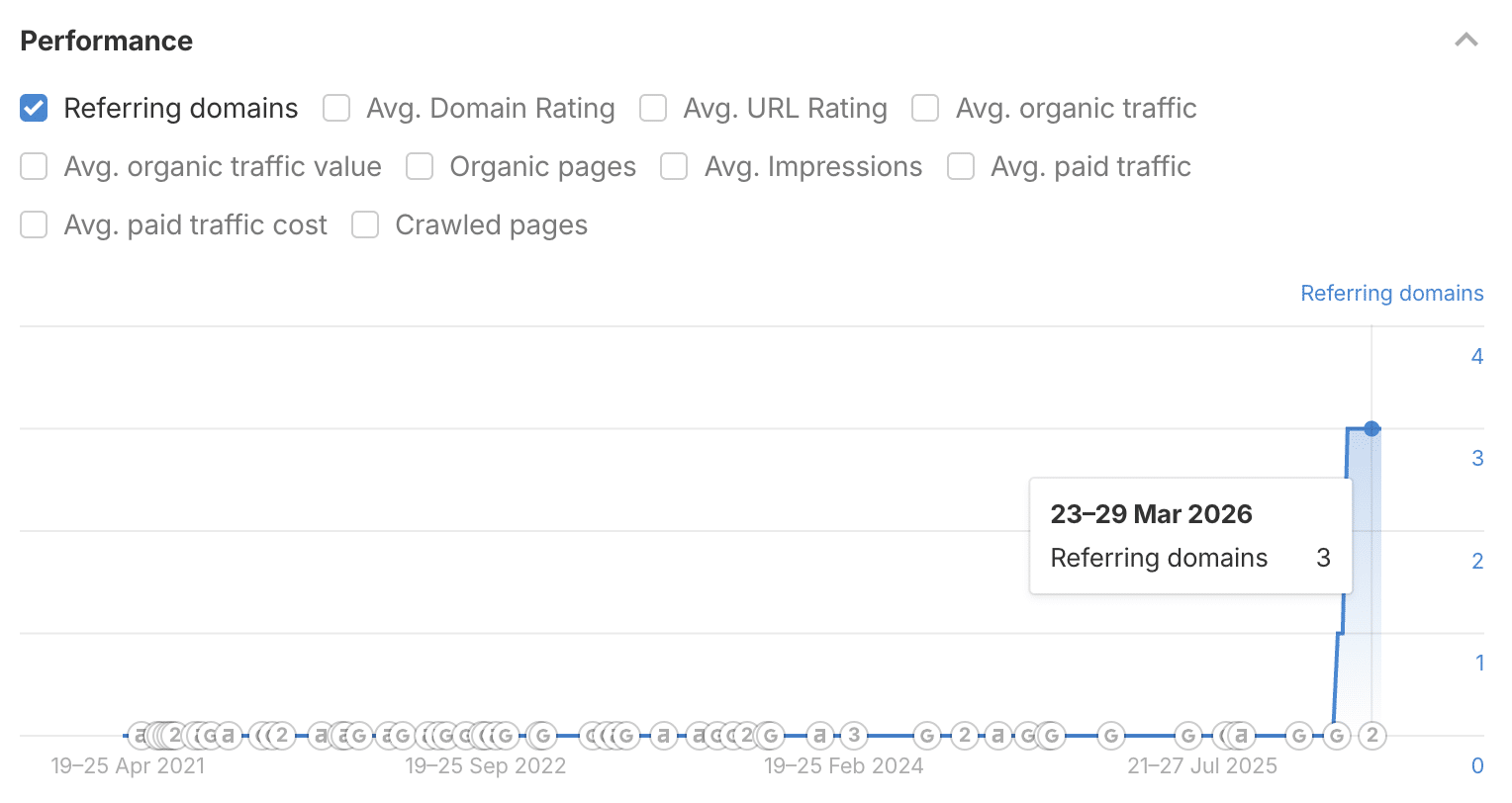
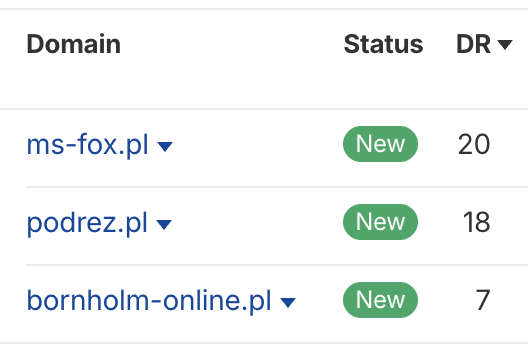
And yet the algorithm reacted enthusiastically. Why?
The key is attribution. Thanks to
Personstructured data and thesameAsproperty, Google doesn’t see these links as “random references from the internet”. It sees them as confirmation of a connection inside one trusted entity.
So we’re talking about results achieved in near-laboratory conditions – without a single link from beyond my direct reach. It’s the best evidence that in 2026, “who” publishes is starting to weigh as much as (or more than) “where” they publish.
Organic mentions in national media
If it’s not the links, then maybe brand mentions? Again the answer is no – at least at launch.
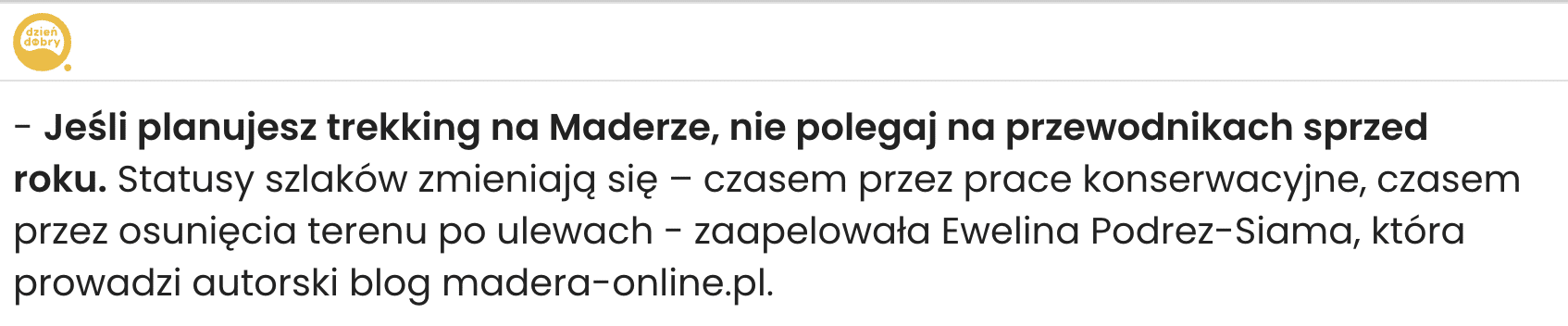
However, on March 19–20, 2026, during the closure of Madeira’s hiking trails after storms, madera-online.pl became a source cited by Poland’s national media:
- Dzień Dobry TVN (March 20, 2026) – national breakfast television, with a direct quote and the credit: “Ewelina Podrez-Siama, who runs the blog madera-online.pl”,
- Wprost Podróże – a major Polish weekly’s travel section, with madera-online.pl as the source of trail status information,
- MSN – article syndication with mentions of the site.
These are organic brand mentions – none of these newsrooms was asked for a mention, none received sponsored material, none even contacted me.
The content was citable, useful and unique.
And here the trust loop becomes visible:
Comparing with the history of the earlier, twin project:
- when I launched bornholm-online.pl, the entity didn’t yet have this travel history – the first results came after several weeks,
- at the same time, the “Bornholm cuisine” category took off faster, because my entity already had three cookbooks behind it. The algorithm had something to hold on to – not in the travel topic, but in the culinary one.
When does the Trust Halo work?
Trust Halo isn’t automatic. It works when, and only when, the new project is consistent with who you are – even if it’s a different niche.
A blog about Madeira made algorithmic sense as the project of a person who has written about Bornholm for years, documents her travels with her own photos, and has a historically grounded interest in specific places.
If I opened a cryptocurrency blog tomorrow – a topic I objectively know next to nothing about – there would most likely be no Trust Halo to speak of. The algorithm doesn’t transfer trust to content with no roots in the entity’s history.
The test before launching a new project
Does a trace exist on the web — content, citations, structured data — that connects this niche to your entity?
Tying a domain to an entity is a double-edged sword
Tying projects to your personal brand cuts both ways. You draw on the authority you’ve built, but every new project puts that same reputation to the test.
- One weak project is a noise signal.
- Several weak projects under one name is a pattern signal.
And algorithms read patterns better than declarations.
So you can’t have your cake and eat it too. Either you build your reputation in the open and carry its consequences, the good and the bad – or you operate anonymously and give up the Trust Halo.
One small caveat here: hidden ownership is getting harder and harder to maintain. WHOIS data, content patterns, linking structures – algorithms recognize connections even without a formal sameAs declaration. Hiding identity and connections is a game for the very persistent.
I map out that kind of multi-domain setup around one name for clients as well, usually once the personal entity audit is done. More on that on the personal brand SEO page.
Trust Halo – and then what?
Trust Halo is wind in the sails, not a guarantee of success. A new domain with a strong entity behind it enters the game with an advantage – faster indexing, a lower trust threshold, less resistance at the start. That’s a real difference, visible in the data. But it’s also all a Trust Halo is. A boost at the entrance, not a guarantee for the road ahead.
Madera-online.pl reached over 4,000 clicks after seven weeks not only because the algorithm “rewarded” my entity:
- behind every impression stands an article written from first-hand experience, with photos from the trail, with information kept current – there are about 25 posts now,
- I also built several useful features, often unique in the Polish niche, such as:
- a continuously updated list of hiking trail statuses,
- a flight cancellation risk calculator (though for now this one excites me more than it excites the users 😉 ),
- updated data on Madeira’s climate and weather,
- and a roundup of Madeira webcams (all in Polish).
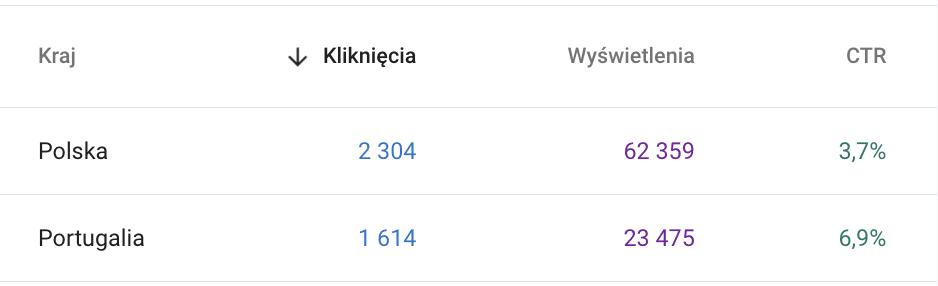
I consider these features key because users can act on them “here and now” – including Poles already on Madeira who need Polish-language sources. That’s the group with the highest CTR:
So the Trust Halo only (and merely) opened the door. The content and its value had to justify the entrance. If weak content stands behind a strong entity – the algorithm will detect it. Faster than with a history-less new domain, because the bar of expectations is higher.
Trust Halo works both ways: the same mechanism that speeds up a good start also speeds up the verification of whether that start was deserved.
Which is why good old SEO isn’t going anywhere. Thankfully 😉 Technical foundations, content structure, answering the user’s actual questions, building links – these remain necessary conditions. Trust Halo lets you meet them with less resistance at the start, but it doesn’t excuse you from meeting them.
In short
The entity opens the door. The content decides whether you stay.
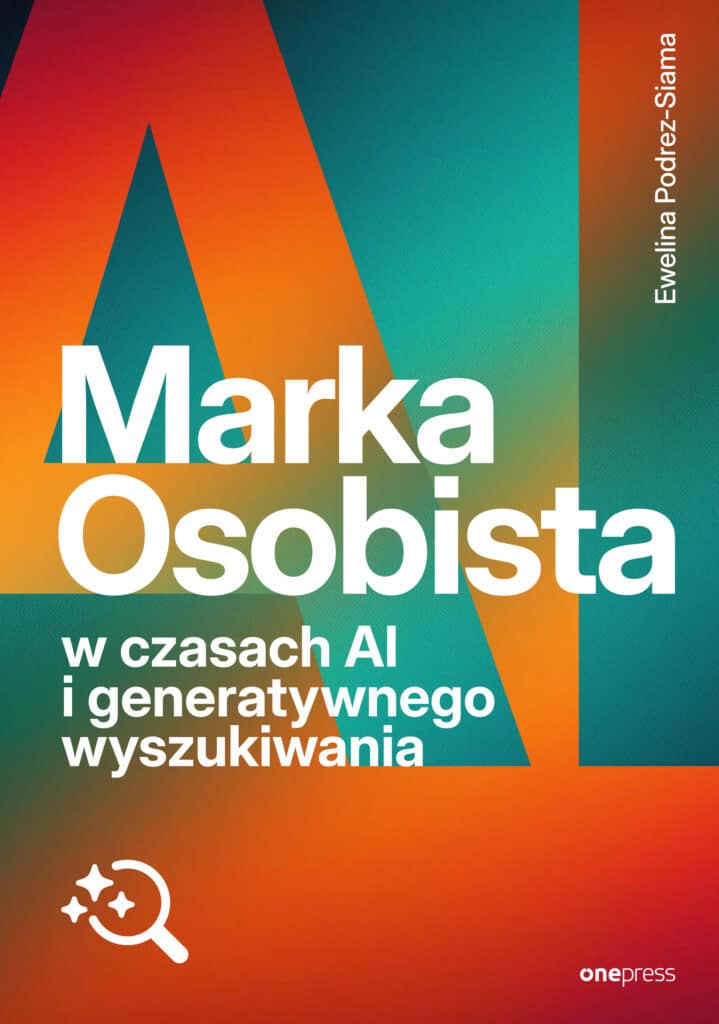
Book · currently in Polish
Marka osobista w czasach AI i generatywnego wyszukiwania
The full Trust Halo case study — with the entity-cleanup data and the complete playbook — is in my book, published in Polish by Onepress/Helion in June 2026. The mechanisms, in English, live on this blog.
About the book →Thorndike’s halo effect says: one positive trait illuminates the whole. Trust Halo says: years of building one coherent entity shine on every new project. The condition is consistency – not the number of projects, not the years spent at the keyboard, but a credible, verifiable history on the web.
Read also:
