

In February 2026 Microsoft quietly shipped AI Performance – a free tool for monitoring your visibility in AI answers. Most SEOs shrugged, because Bing is nobody’s first tab. Then I opened the report, looked at the phrases AI systems use to pull my content into answers, and laughed out loud. It felt like the good old days of SEO. More on that in a moment.
What is AI Performance in Bing Webmaster Tools?
AI Performance is a free report in Bing Webmaster Tools, available in public beta since February 2026. It shows how your content gets cited in AI answers – in Microsoft Copilot, AI summaries in Bing results and, as Microsoft puts it, “select partner integrations.” You get first-party data: how many times your pages were used as a source, which URLs were cited, and how that number changes over time.
Why does a free report like this fly under the radar? Because Bing’s market share makes it easy to dismiss – everyone stares at Google and Search Console instead. In this case, dismissing it is a mistake. Google did launch its own Generative AI report in Search Console on June 3, 2026, but it’s rolling out gradually, only to part of all properties. For now it shows impressions, URLs, countries, devices and change over time. What it doesn’t show: grounding queries, citations, or citation share.
You can of course monitor AI visibility with external tools – I do, I test them, I experiment – but at scale that can cost more than a decent-sized campaign. Which brings us back to the Bing report: available right now, and free.
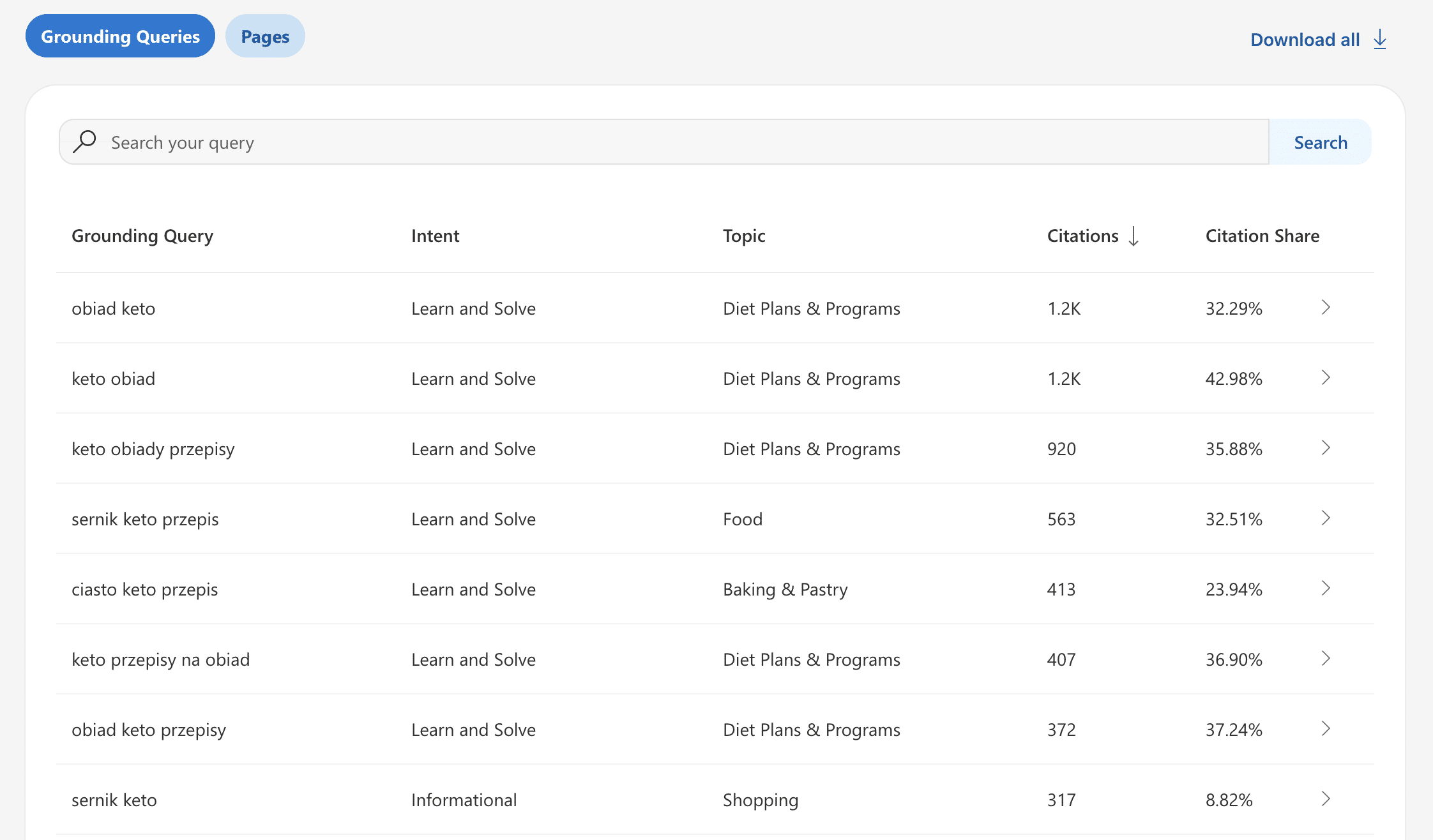
Inside the report you’ll find, among other things:
- grounding queries – the phrases the AI system used to retrieve content,
- intent – the intent Bing assigned to the query,
- topic – the subject area or topical cluster,
- citations – the number of citations,
- citation share – your domain’s share of citations for a given grounding query,
- citation activity at the level of individual pages,
- compare – change between time periods.
A solid dose of data. How do you get to it?
Now for the practical part – how to use this data. Let’s start by pinning down what grounding queries actually are.
What are grounding queries?
A grounding query is the phrase an AI system used to retrieve content for an answer – not necessarily what the user typed. It’s the machine’s search language, not the human’s literal words.
In simplified terms, it works like this: you ask Copilot a question in natural language. The prompt can be long and stuffed with context, because that’s how we usually talk to a language model. Before the model answers, the system may break the prompt into shorter search phrases and use them to find the material it will build the answer on. Bing shows some of those phrases as grounding queries.
So you don’t see the user’s full prompt, nor a complete log of every search the system performed. You see a sample of the phrases that led to your content being retrieved and cited.
Grounding queries in practice
Now look at what the machine actually types to pull my content:
- From the podrez.pl report: “pozycjonowanie”, “pozycjonowanie strony”, “pozycjonowanie SEO”, “pozycjonowanie stron” – Polish variants of “SEO” and “website ranking”.
- From my keto food blog ms-fox.pl: “obiad keto”, “keto obiad”, “keto obiady przepisy”, “keto przepisy na obiad”, “obiad keto przepisy” – all permutations of “keto dinner recipes”.
Plain keyword phrases, the same ones SEOs have worked with for years. That’s why the report made me laugh – there’s something ironic in it for GEO: it looks exactly like what I see every day in the Performance section of Search Console. Queries deeply characteristic of a classic search engine and classic SEO.
The report also makes one thing immediately visible: the phrases operate in topical clusters. One user intent gets broken by the machine into several, sometimes a dozen, query variants.
Query fan-out vs grounding queries – what’s the difference?
From Google we know the term query fan-out, and it may naturally remind you of grounding queries. The two concepts are close relatives, not the same thing.
Query fan-out is Google’s name for the mechanism of splitting one complex question into many related sub-queries – the same one that powers AI Mode. Grounding means anchoring an AI answer in sources and evidence from the web. And grounding queries is the name Bing gives to the phrases used to retrieve the content later cited in an answer.
You could say both terms describe neighboring parts of a similar process: the system first has to understand the question, then find material it can safely build the answer on. But don’t treat them as synonyms, and don’t assume the Bing report shows the exact mechanism Google calls fan-out.
So why does Bing say “grounding queries” and not “fan-out“? Because the name describes what the report actually shows: the phrases an LLM used to retrieve sources. We have no public view into Copilot’s full architecture, nor into the order of every step the model takes before answering.
For a practitioner, the naming difference is secondary. What matters is that you get to see the layer of queries the machine composes on its own to find and verify your content.
AI visibility monitoring: what AI Performance measures – and what it doesn’t
AI Performance measures visibility, meaning citations – not AI traffic. It shows how many times, and for which phrases, your content was used as a source. It won’t tell you whether anyone visited your site as a result.
On June 16, 2026 Microsoft added four features to the report: Citation Share, Intents, Topics and Compare. These are what turn a raw counter into a working tool. The key metric is Citation Share – according to Microsoft, it’s calculated as your site’s share of all citations shown for the same grounding query. You hold 3 out of 10 citations for a phrase? Your share is 30%. Mechanically it’s an old friend of CTR, except nobody’s clicking anything here.
One caveat: share tells you how big your slice of the pie is, but not who ate the rest. It’s also not a traffic share, not a ranking, and not a content quality score.
| Metric | What it shows | What it doesn’t show |
|---|---|---|
| Total Citations | how many times a page was cited | whether it translated into traffic or conversions |
| Citation Share | your share of citations for a given phrase | who holds the rest, your ranking, or your traffic share |
| Grounding queries | a sample of phrases the system used to retrieve content | the exact prompt the user typed |
| Intents / Topics | the intent and topic assigned to queries | your page’s position or role in a specific answer |
Note that the data is aggregated across the supported AI surfaces, so you can’t separate Copilot from AI summaries in Bing. And the grounding queries list is a sample, not a complete record of every query.
By default the report covers the last 30 days; the Compare view lets you set longer and shorter ranges side by side and track change over time.
Does AI Performance show ChatGPT data?
Don’t treat AI Performance as a ChatGPT visibility report. Microsoft names Copilot, AI summaries in Bing, and unnamed “select partner integrations” – but doesn’t disclose which services that last category covers.
If you know the mechanics of ChatGPT and its relationship with Bing, the conclusion that AI Performance includes ChatGPT data may feel natural – but I found no formal evidence for it. The citations visible in Bing Webmaster Tools cover only the AI surfaces Microsoft reports on. They are not proof that a page was cited in ChatGPT, let alone (this part should be obvious) in Perplexity, Gemini or Google AI Overviews.
The distinction matters, because search architectures and the sources different systems use can change. Grounding queries from Bing are a very valuable clue – not a universal report for the whole AI market. If you want to know what a model knows about you in the first place, and where it gets that from, I wrote separately about how RAG builds its picture of your brand.
How to read the AI Performance report – a four-site example
Read the report through two columns at once: citation count and share. The count alone only tells you how “loud” a phrase is. The share tells you how much of that voice belongs to you. I’ll show it on four of my own sites, spread across unrelated niches: SEO, keto cooking, and two travel blogs.
| Site | Grounding queries | Total citations | Highest share | Dominant intent |
|---|---|---|---|---|
| podrez.pl | 9 | 4,026 | 36.94% | Informational |
| ms-fox.pl | 138 | 11,931 | 60.00% | Learn and Solve |
| bornholm-online.pl | 7 | 927 | 56.60% | Commercial / Planning |
| madera-online.pl | 5 | 991 | 34.38% | Others / Informational |
Data: AI Performance in Bing Webmaster Tools, last 30 days, exported June 25, 2026.
The best small proof that a keyword alone is no longer enough sits in the podrez.pl data:
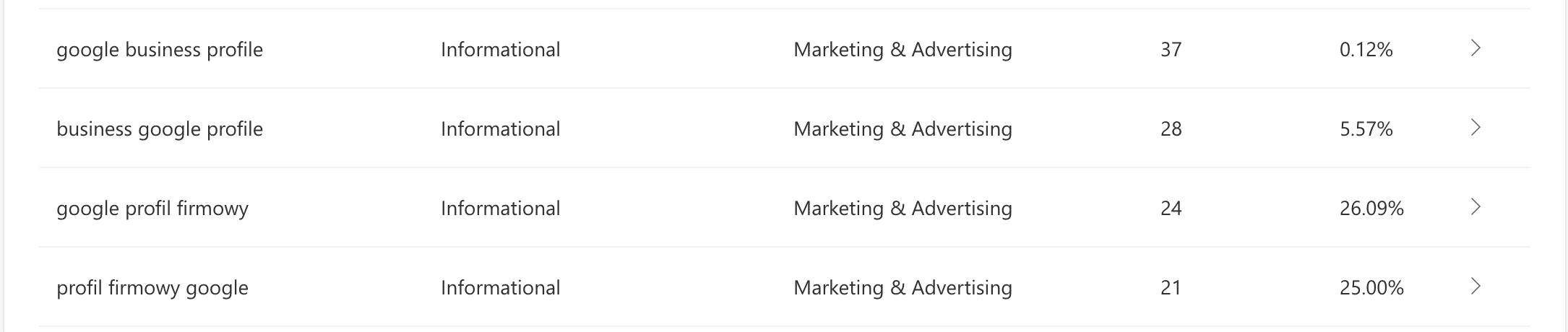
The phrase “google business profile” – 37 citations, but a 0.12% share. So I show up for a big English-language query, and my slice of it is negligible. Meanwhile “google profil firmowy” in Polish – 24 citations and a 26.09% share. Same content, two languages, and the machine clearly credits me with only one of them. Which is fair: the English version of that post doesn’t exist yet. The report just handed me the argument for writing it – the same argument, incidentally, that this very article you’re reading is a response to.
Intents and topics: Bing’s actual taxonomy
Most guides assume the classic split into navigational, informational and transactional queries. Bing uses its own, broader taxonomy. In my data, among others:
- Learn and Solve – dominant by a wide margin: 118 phrases,
- Informational – 17,
- Commercial – 13,
- Planning – 4,
- Others – 4,
- Local – 1,
- Comparison – 1.
One phrase came back with no intent label at all.
On top of that, the topics:
- Diet Plans & Programs,
- Shopping,
- Search Engines & SEO,
- Marketing & Advertising,
- Travel,
- Government Services & Benefits.
Taken together, at the level of each site, this is a genuinely interesting read on what topic the machine is starting to consider you an expert in. Just remember that Intents and Topics are classifications still being developed in beta. In niche areas, the labels can be extremely broad or plain imperfect.
New · October 13, 2026
Topics Portfolio is a new tab in AI Performance. It groups your grounding queries into topics, shows how big and crowded each one is, and lists “opportunities”: queries where AI cites other sites and not yours.
I tested it on 51 sites. Of 972 opportunity queries, four were in Polish, and a large clothing store got shoes it doesn’t carry. Your own queries within topics are worth far more.
Topics Portfolio in Bing Webmaster Tools: test results and how to use it →
The highest citation count can be worth the least
A raw citation count without context can mislead you. On madera-online.pl, my Madeira travel blog, the phrase “simplifica madeira” has an impressive 836 citations. Sounds like a win for a small travel blog – until you look one column over: a 2.78% share. It’s a query about a Portuguese government service, and my blog is a tiny fraction of it.
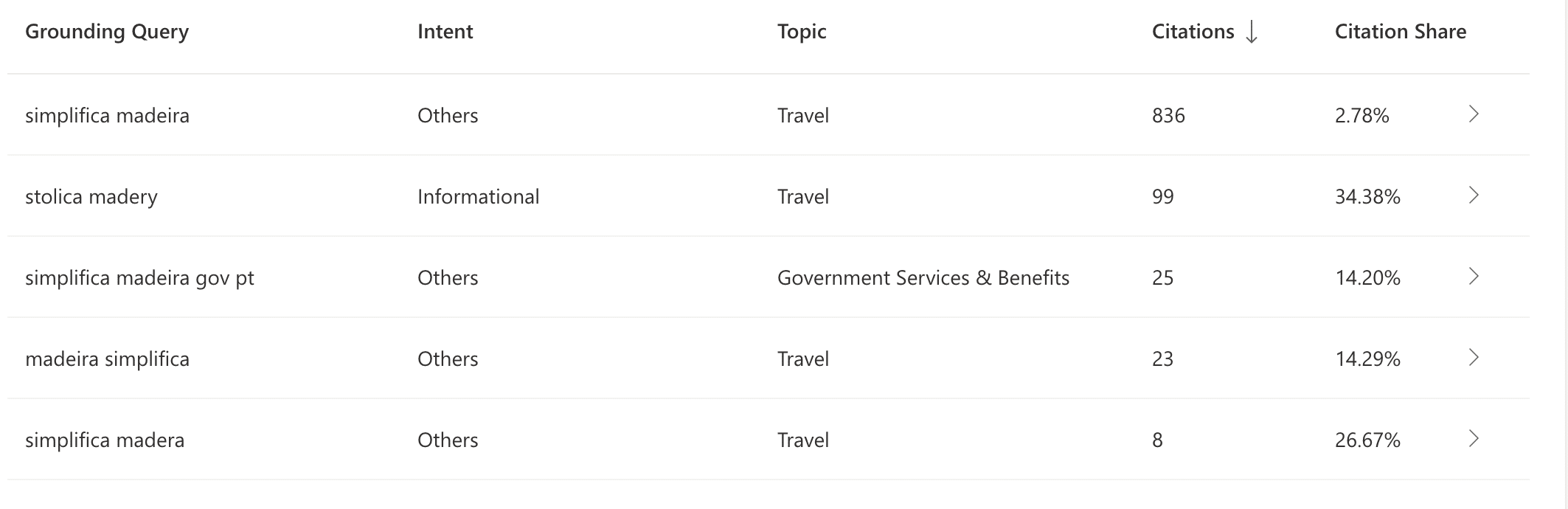
And “stolica Madery” (“the capital of Madeira”)? Only 99 citations, but a 34.38% share. That’s a phrase I genuinely “own”. If I looked at citation counts alone, I’d be celebrating the wrong thing.
How to work with grounding queries, step by step
Treat grounding queries as a gap analysis, not a scoreboard. The citation count is for admiring and for trend-watching at best; the query list is the material for real work. That work splits into three analyses: what the model is searching for, which of your pages it takes into answers, and what to do about it in SEO terms.
Step 1. Grounding queries analysis: what the machine is looking for
Export your grounding queries. This is the most valuable file in the entire report: a sample of the language the system associates with your content. Read it like a dictionary – watch the phrasing, the dominant intent, and the clusters, meaning one need broken into several variants.
Write down the surprises – phrases that never made it into any content plan. Or pages you’d long forgotten about that turn out to be worth refreshing.
Separate real signal from possible noise, too: long, highly technical strings can sometimes come from automated tests or one-off unusual queries.
Step 2. Cited-page analysis: what the AI actually cites
Now drop from the phrase level to the URL level (by clicking into a specific query). The report shows which of your pages gets cited for a given grounding query and what your share is. Is the cited page the one you’d expect, or did the model grab something random? Do you hold a strong position for the phrase, or are you a sliver of all citations?
The report won’t show you competitors’ domains, so for priority phrases it’s worth checking the results manually in Bing. After this step you know which page is the one to work on.
Step 3. SEO analysis and optimization: what to do about it
Check whether the cited page speaks the language of the grounding query and serves the assigned intent – or only your own version of the topic. Put a direct, essential answer to the query in the first paragraph of the section, bolded, so the model can lift it and cite it. Make sure the page is cleanly built: good headings, tables, examples, answers a human can find fast. Strengthen the existing page instead of spinning up a new URL for every phrase variant, link to it internally, remember BLUF – bottom line up front. And you know what’s paradoxical about all this? None of it is a new AI trick. It’s good old SEO: a clear answer to the query’s intent, a readable structure, and a topic covered properly.
How does this map to Google? Many generative systems split complex questions into smaller queries and search in several steps – but the specific mechanisms and phrases differ between platforms. Grounding queries from Bing are a reference pattern for analysis, not a stencil for Google, ChatGPT or Perplexity.
Google now has its own visibility reports for generative features in Search Console, rolled out to part of all properties – but it still shows no query fan-out and no Citation Share. Which is why every interesting phrase from Bing is worth checking manually in Google as well.
Export your grounding queries today
Open Bing Webmaster Tools, go to AI Performance and download your grounding queries list. Pick three that surprised you – phrases you would never have put in a content plan yourself. Then check: does your page even speak that language? If not, you have your first task for tomorrow.
Because that’s the whole point of this report: Microsoft shows you, for free, the gap between what you write about yourself and how your site actually gets cited. The rest is solid SEO you’ve known for years – it’s just that someone else is suggesting the keywords now.
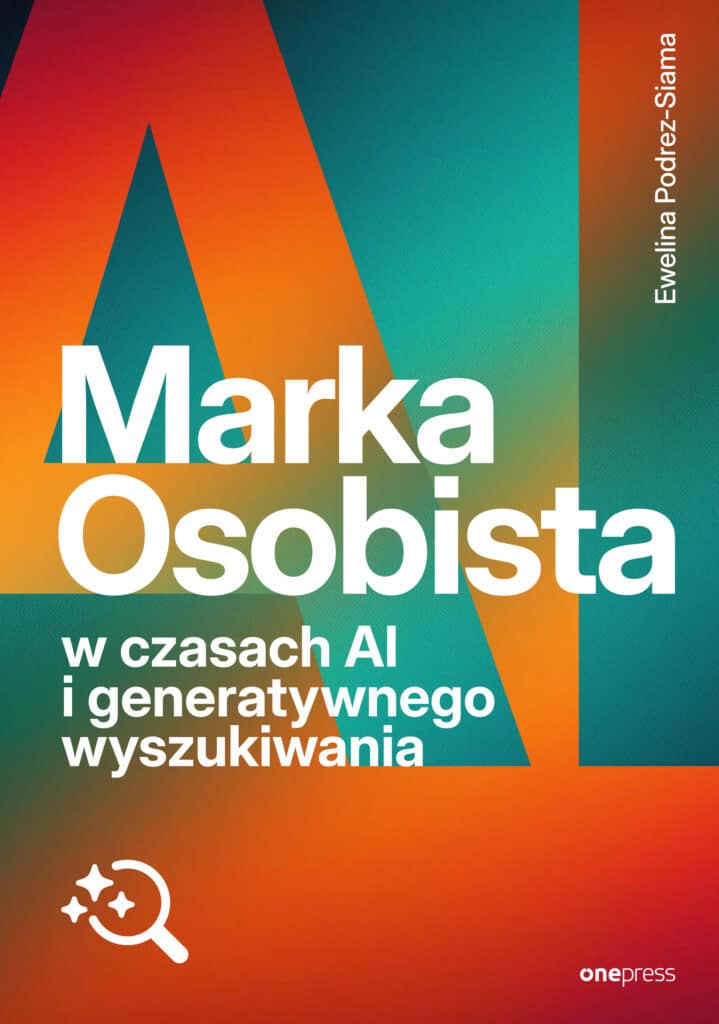
Book · currently in Polish
Marka osobista w czasach AI i generatywnego wyszukiwania
Grounding queries are just the tip of the iceberg in the new search reality. The full case studies and the deeper mechanics of brand visibility in the generative era are in my book – published in Polish by Onepress/Helion in June 2026. The mechanisms, in English, live on this blog.
About the book →
Loved the “simplifica madeira” example on reading count and share together. We saw something similar the other way round: one checklist page carried 54.6% of our site’s page-level Bing AI citations (3,258 of 5,969), so a single URL was most of our AI footprint.