

As of November 21, 2026 · examples from my Wikidata item, the structured data on podrez.pl and a sample store selling coffee machines
Semantic SEO means making sure Google and language models like ChatGPT understand what you write about, rather than just matching words. Google looks for specific things in a text: people, companies, products, places and concepts. It also checks what connects them: who wrote what, who makes what, what is part of what. In SEO we call these things entities, and the connections between them relationships.
Let’s take a simple question: “Who wrote Marka osobista w czasach AI?” (that’s my book, Personal branding in the age of AI). For Google and ChatGPT to answer correctly, they need to know which book you mean, which person, and what connects them. Here, it’s authorship. The book, the authorship and the person together make a semantic triple.
In short
A semantic triple (knowledge triple) is one fact in the form subject → relation → object, e.g., book → author → person. Each part can have an identifier: an ISBN, a GTIN, a tax number or a Wikidata item number.
What about AI? Google says AI Mode draws on the Knowledge Graph, among other sources. Language models learn facts from text and knowledge bases. An unambiguous description makes it easier for them to work out which book, person or product version you mean.
What it isn’t: a list of synonyms to scatter across your text, even though many guides describe it that way.
Where do you start with semantic SEO? With the reader’s question and one clear sentence on the page that answers it. Structured data and Wikidata help confirm facts, but they aren’t a requirement.
What is semantic SEO?
Semantic SEO means optimizing for meaning rather than for matching words. You start with the reader: what thing they are asking about and what they want to find out about it. Then you check whether the page makes it clear which things it describes, what it says about them and how they are connected.
Semantics: one word, three meanings
Semantics is the branch of linguistics that studies the meaning of words and sentences. It matters in SEO too, where what counts is what a text means, not just which words it’s made of.
Take “bank”. It can be the place that keeps your money, the side of a river or a pile of snow. Only “the Bank of England” points the reader to one specific thing. Clear? A search engine looks for the same kind of clues and does best when the context leads to one bank (or one riverbank, if money was never on your mind).
Entity, attribute, relationship
You need just three concepts to talk about semantic SEO:
- An entity is a thing you can recognize unambiguously and tell apart from others: a person, a company, a product, a place, a concept. Coca-Cola is an entity. Ewelina Podrez-Siama is an entity. The Bank of England is an entity. “A sweet drink with a red label” isn’t one yet, because it fits many drinks.
- An attribute is a property of an entity together with its value: a book’s publication date, a product’s price, a company’s tax number, a store’s address.
- A relationship connects two entities: a book has an author, a product has a brand, a store belongs to a company.
An entity is easiest to recognize by its identifier, because names get reused and can be ambiguous. Examples include a book’s ISBN, a product’s GTIN, a company’s tax number or a Wikidata item number.
Semantic search vs semantic SEO
Semantic search is Google’s side of things: systems that try to understand the meaning of a query and of a document. In May 2012 Google launched the Knowledge Graph under the slogan “things, not strings”. I tell the rest of that story, along with search intent, in Entity, context and intent, and explain how the graph and the Knowledge Panel work in Knowledge Graph and Knowledge Panel.
Semantic SEO is your side. You give these systems content and data in which things and relationships are unambiguous. Google understands more and more on its own, but it won’t guess which of several people with the same surname wrote your book.
Semantic SEO vs semantic HTML
Semantic HTML is a different topic with a similar name. It’s about tags that tell the browser and screen readers what a part of the page is: <header>, <nav>, <article> or <h2> instead of plain <div> tags. It improves accessibility and gives the document structure, but it describes how the page is built, not the real-world things the page talks about. Semantic SEO deals with entities and relationships.
What is a semantic triple?
Definition
A semantic triple, also called a knowledge triple or an RDF triple, records one fact in three parts: subject, relation (predicate) and object.
It’s a bit like parsing a sentence in school. In the sentence “Ewelina wrote a book”, the subject is “Ewelina”, the verb is “wrote” and the object is “a book”. The difference is that in a triple each part can have an identifier, and the relation comes from a fixed vocabulary.
The object of a triple can be another entity (e.g., the author) or a value (e.g., the publication date). This kind of triple is the basic unit of data in the W3C’s RDF standard. A set of triples forms a graph: subjects and objects are its nodes, and relations are its arrows.
Wikidata records facts in a similar but richer way. A statement consists of a property and a value attached to an item, and it can also have qualifiers (e.g., a start date) and references, i.e., sources. Item identifiers start with Q, property identifiers with P.
One fact in three places: my book
I wrote the book Marka osobista w czasach AI i generatywnego wyszukiwania (Personal branding in the age of AI and generative search, Onepress 2026). Here is how that fact looks on my website, in structured data and in Wikidata.
The same fact in three records. Data from podrez.pl/o-mnie/ and Wikidata, accessed November 19, 2026. My own diagram.
The page says it to people. Schema.org says the same thing to machines, still on my domain, and Wikidata records the fact outside it. In both machine-readable records the book has an author, and the names come with the same identifiers: Q140363900 for the book and Q133444548 for me (in schema.org, through sameAs). Thanks to them, nobody has to guess which book and which Ewelina we mean.
This is how I record authorship in the structured data on podrez.pl (simplified):
{
  "@context": "https://schema.org",
  "@graph": [
    {
      "@type": "Book",
      "@id": "https://podrez.pl/#book_marka_osobista",
      "name": "Marka osobista w czasach AI i generatywnego wyszukiwania",
      "isbn": "978-83-289-3727-7",
      "author": {
        "@id": "https://podrez.pl/#person"
      },
      "sameAs": "https://www.wikidata.org/wiki/Q140363900"
    },
    {
      "@type": "Person",
      "@id": "https://podrez.pl/#person",
      "name": "Ewelina Podrez-Siama",
      "sameAs": [
        "https://www.wikidata.org/wiki/Q133444548"
      ]
    }
  ]
}
Structured data should describe what is visible on the page. That’s why the authorship of the book also appears in plain text on my About me page.
The type of relation matters
In my Wikidata item, the same two entities are also connected by another relation: Q133444548 → P800 (notable work) → Q140363900. It looks similar, but it says something else. “Ewelina wrote this book” is authorship. “This book is one of Ewelina’s notable works” is a judgment about what matters most in her body of work. The exact equivalent of author in schema.org is P50 in the book’s item, not P800 in mine. Before you choose a property, read its description and usage examples (e.g., Property:P50). In a store, the same goes for brand and manufacturer: the brand on the label and the manufacturer aren’t always the same company.
Why a triple is unambiguous and a sentence isn’t
The meaning of a sentence depends on grammar, context and whether the reader knows the names. “Podrez’s book” could mean any of my seven publications. A triple with identifiers doesn’t have that problem: Q140363900 is one specific book, and /g/11md2bpb8_ is exactly one node in Google’s Knowledge Graph, which is me. If your entity has a Knowledge Graph identifier (you can check with my tool Are you in Google’s Knowledge Graph?), you can add it to Wikidata under property P2671. In my item, that’s /g/11md2bpb8_.
How to describe a person or company entity
One stable @id for the whole domain
A person or a company should have one node with a stable @id in the structured data, shared across the whole domain. Posts, service pages and the About me page then point to that same node instead of describing someone from scratch each time. In sameAs, list only profiles that really describe that person or company, and for an ambiguous topic add a Wikidata identifier in knowsAbout. My node is https://podrez.pl/#person, with sameAs pointing to Wikidata, Google’s Knowledge Graph, ORCID and VIAF. For the topic “SEO”, the identifier shows which concept I mean.
I explain which URLs belong in sameAs and how to check them against Wikidata in sameAs schema.
Wikidata: a statement without a reference documents nothing
For every statement that is meant to confirm a fact, add a reference to a source anyone can open: a publisher’s catalog, a register, an event organizer’s page.
Relationships as a graph
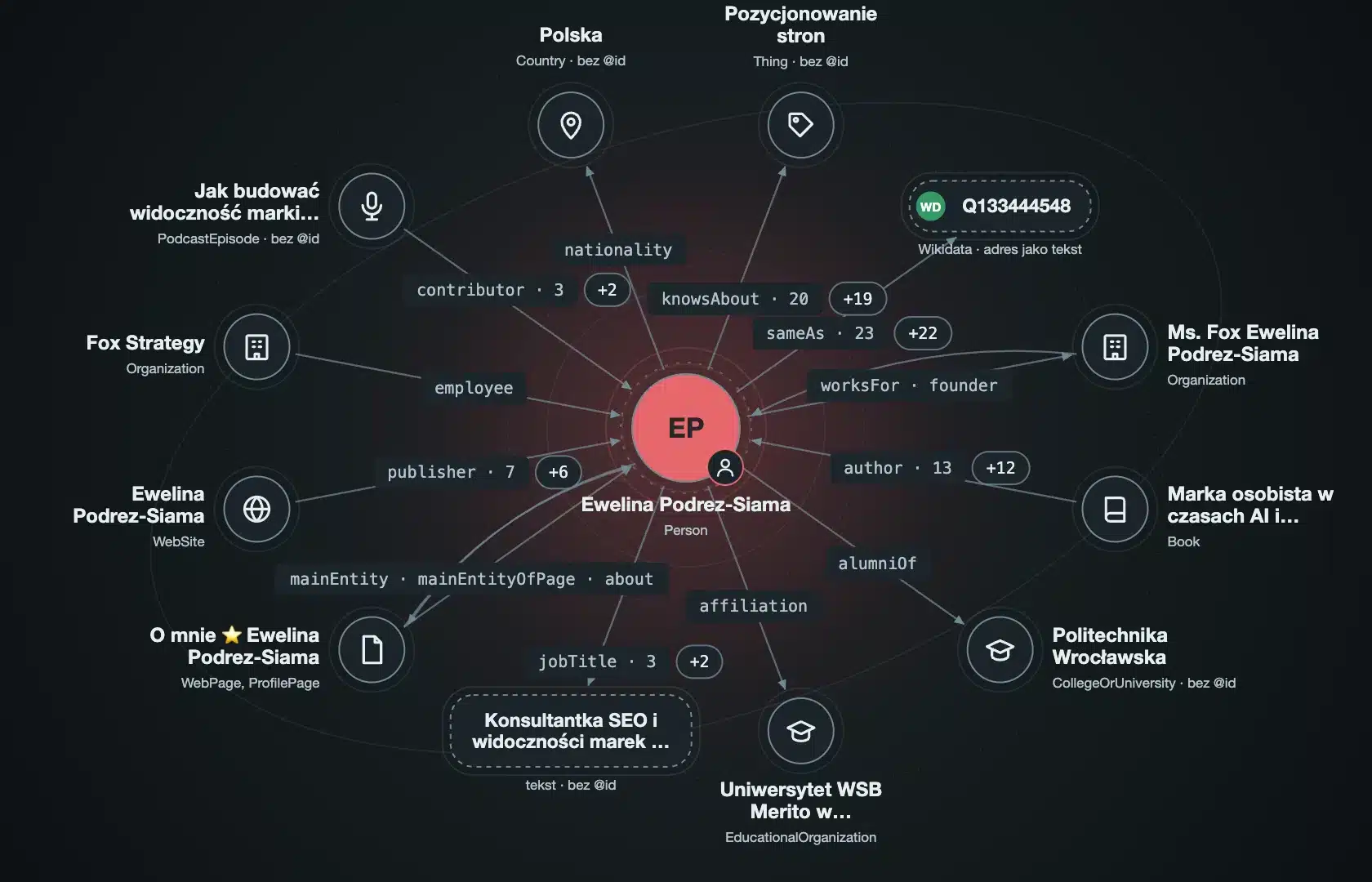
Knowledge triples are easiest to understand when you can see them. The Entity Observatory reads a page’s structured data or a Wikidata item and draws it as a graph: each arrow runs from subject to object and is labeled with the name of the relation. On the map, check whether the arrows from different pages lead to one node for the person or company, not to several copies of it. The screenshot below shows my About me page.
Semantic SEO and AI
Entities in AI Overviews and AI Mode
Google says AI Mode draws on the Knowledge Graph, among other sources (AI Mode announcement, March 2025). AI features in Search can also break a question into several related searches (query fan-out) and pull pages on different subtopics into the answer.
My hypothesis: fan-out queries ask about specific things and their attributes. When a page names entities clearly and gives their attributes, more of its passages match those searches.
Triples in language models
Triples can be turned into plain text for language models. In the KELM project, Google researchers converted about 45 million Wikidata triples into about 18 million sentences. They added them to the text corpus searched by the REALM model (before that, it held only Wikipedia). Then they checked how accurately the model answered factual questions. Sentences built from triples did better than raw triples strung together.
This study doesn’t prove that Google uses this in Search. I collected more studies and a Google patent on Wikidata triples as training data in my guide Wikidata step by step. I explain how models combine what they remember with the pages they retrieve in my post Your brand in LLMs.
Beyond what they remember from training, AI Mode and ChatGPT search pull in search results in real time. OpenAI says ChatGPT usually rewrites a question into one or more queries and sends them to its search partners. Both systems can draw on selected passages from the pages they find and point to their sources in the answer. That’s why it matters whether a single passage makes sense without the rest of the text.
What this means for your content
One fact, one sentence
Who, what and when, without splitting it across several sentences. A passage lifted out of your text into an AI answer has to hold up without the paragraph next to it.
The same facts everywhere
Your page, structured data, profiles, Wikidata, product feed. When two places show different numbers or dates, AI may repeat either of them.
Identifiers instead of descriptions
“Our flagship model” tells a machine nothing. A model number and a GTIN do.
Sources beyond your site
A fact confirmed by independent sources is easier to verify than one that exists only on your site. I write more about this in GEO vs SEO.
Semantic SEO on a large site
You can check one book by hand. A store with 20,000 products holds hundreds of thousands of facts like this, and nobody is going to fix them one by one. On a large site, semantic SEO relies on templates, database fields and linking rules. Let’s take a store that sells coffee machines.
The site’s entity map
Start with a list of the things the store describes and the relationships between them. For coffee machines it might look like this:
| Subject | Relation | Object |
|---|---|---|
| Coffee machine (model) | has brand | brand (brand page in the store) |
| Coffee machine (model) | belongs to category | portafilter espresso machines |
| Variant (color, capacity) | is a version of | a coffee machine model |
| Coffee machine (model) | has accessories | grinder, filter, descaler |
| Guide | describes | the category and specific models |
| Store | belongs to | a company (tax number, address) |
For each type of entity, you decide which page is its “home” (product page, brand page, category), which identifier you recognize it by and which attributes are mandatory. A brand page in a store doesn’t have to be just a list of products. It’s a good place to describe the brand as an entity.
Structured data from templates
In a store, structured data comes from a template and database fields. So an error in the template is copied to thousands of pages, but so is the fix.
- Products with identifiers. Google recommends including all the global identifiers a product has (GTIN, and ISBN for books), plus the brand (
brand) and the manufacturer part number or your store’s SKU (mpn,sku). - Variants as a group. Colors and capacities of the same model are tied together by
ProductGroup(withhasVariant,variesByandproductGroupID). That way, versions don’t pretend to be separate products. - A company with identifiers. The store’s
OrganizationwithsameAspointing to the company’s profiles and with identifiers such as a tax number (in Poland, the NIP) invatIDortaxID. Google says someOrganizationproperties, e.g.,iso6523Codeornaics, help it tell your company apart from others. Show the tax number in visible content too, e.g., in the footer or on the contact page. - A stable @id for the brand and the company. Every product page uses the same @id for the brand and the company, with at least the name alongside it. Google reads the data on each page separately, so a bare reference to a node on another page isn’t enough.
Linking by relationship
Relationships show in links too. A product page links to its brand, its category and matching accessories. A guide leads to the models it discusses, and a brand page to its product lines. The anchor text names the thing (“espresso grinders”), not “click here” or a keyword tacked on. I write more about building these connections in Topical authority and topic clusters.
Consistency and spot checks
The same product is usually described in several places: on the product page, in structured data, in the Merchant Center feed, on price comparison sites and on marketplaces. When one place has a different name, price or GTIN, machines get conflicting facts.
Take a coffee machine in black and in silver. Each variant has its own GTIN, and both belong to the same ProductGroup. When both variants are on one page, the markup doesn’t change when you pick a color, so it has to describe every variant with its GTIN from the start. The error appears when the template puts the default version’s GTIN into both variants. Then, in the JSON-LD, the silver machine has the black one’s number.
Google builds the Shopping Graph from this kind of product data (over 60 billion offers according to Google, May 2026), and shopping in AI Mode runs on Gemini connected to that same graph. In its documentation on AI features, Google also advises keeping your data up to date in Merchant Center and in your Business Profile.
You don’t check 20,000 product pages. You take a few URLs from each template (product, variant, category, brand, guide) and compare the name, GTIN and brand on the page, in the JSON-LD and in the feed. A template error usually repeats on every page built from that template, so a few URLs are enough to spot it. You can check the markup against Google’s requirements in the Rich Results Test and in the Search Console reports for product snippets and merchant listings, and see the relationships between nodes in the Entity Observatory.
I build entity maps and structured data for stores and brands as part of my Entity SEO work.
Semantic keywords: what to collect before you write
“Semantic keywords” aren’t synonyms you have to cram into a text. They aren’t “LSI keywords” either. In July 2019 Google’s John Mueller put it plainly: “There’s no such thing as LSI keywords”. A good article will naturally use the vocabulary of its field. Instead of counting words, collect these before you write:
Things the topic can’t exist without
For this post: Google, Knowledge Graph, Wikidata, schema.org, entity, triple.
Attributes people ask about
For a book: author, publisher, year, ISBN. For a coffee machine: pressure, water tank capacity, built-in grinder, price.
Relationships that connect these things
Who wrote what, what goes with what, what is part of what.
Questions
From the “People also ask” section, autocomplete suggestions and Search Console queries. They show which attributes and relationships matter to people.
Terms with zero volume in Ahrefs
The Polish term for “semantic triple” gets 0 searches a month in Poland (Ahrefs, November 2026). Even so, it’s hard to explain this topic without it.
Suggestions from a language model, but checked
ChatGPT or Gemini will quickly list entities, attributes and relationships for a topic. Treat that as brainstorming: confirm the facts in Wikidata or the Knowledge Graph, because a model can make them up.
You then use the “semantic keywords” collected this way to build your sections, links and structured data. No counting repetitions.
Semantic SEO in practice: 6 steps
The same steps work for one book and for a store with thousands of product pages.
- 1Start with the reader’s question
What thing are they asking about, and what do they want to know about it? One page, one main thing: a person, a company, a service, a product, a concept.
- 2Write relationships out plainly
“The book was published on June 9, 2026” says more than “our latest publication”. A short sentence that shows the thing, the relation and the value is a ready-made triple.
- 3Mark them up in schema.org with @id and sameAs
A stable @id for every important thing on the page, and sameAs to Wikidata, Wikipedia or an industry database if the thing has an entry there. On a large site you do this once, in the template. Choose the relation that says exactly what you mean. Remember P50 and P800?
- 4Confirm them outside your site
Wikidata with references (if you meet its requirements), industry databases, registers, media mentions. On your own site, anyone can write whatever they like about themselves. For a book, that source is the publisher’s catalog or the national library catalog; for a company, the business register (in Poland, KRS or CEIDG); for a product, the manufacturer’s website.
- 5Link by relationship, not by keyword
A post about a book links to the author, a product to its brand and accessories, a concept to the broader topic.
- 6Check what machines see
The Rich Results Test shows whether Google can read your markup. The Entity Observatory draws the relationships in your data, and my tool Are you in Google’s Knowledge Graph? checks whether Google connects your name with an entity.
What semantic SEO won’t do for you
With semantic SEO, it’s easy to promise too much. Here’s what it won’t do.
Structured data won’t lift your rankings on its own
Google says plainly that it isn’t a general ranking factor. It does help Google understand the page and makes it eligible for rich results.
The Knowledge Graph doesn’t take submissions
A Knowledge Panel appears when Google considers an entity well confirmed. In my experience, Wikidata helps with that. You can claim an existing panel and suggest corrections to it.
Search Console has no entity report
As of November 20, 2026, you won’t find a filter for entities or for the Knowledge Graph there either. You have to measure it another way: with the Knowledge Graph Search API, by checking AI answers and with your own tools.
There’s no “for AI” markup
According to Google, you don’t need special structured data to appear in AI features in Search. The same basics as in regular SEO still apply. My own addition: confirmation from outside sources.
One thing to do after reading this post
Pick one fact about yourself, your company or a product, for example the authorship of a book or the brand of a coffee machine. Check whether your page, your structured data and outside sources all state that fact the same way, and whether the identifiers point to the right book, person or product version.
Frequently asked questions
How is semantic SEO different from traditional SEO?
Traditional SEO often starts with a keyword and a page built for that keyword. Semantic SEO starts with things and relationships: what the page is about, what it connects to and how to confirm it. You still need technical SEO, content and links, and semantic SEO gives structure to what you build on top of them.
Do LSI keywords work?
Not as a Google mechanism. In July 2019 Google’s John Mueller wrote that there is no such thing as LSI keywords. LSI is an information retrieval method from 1988–1990 (Bellcore), tested on small document collections. A good article will naturally use the vocabulary of its field, but counting those words doesn’t improve rankings.
How do you find semantic keywords?
Build an entity map instead of a list of synonyms. Collect the things the topic can’t exist without, plus their attributes (e.g., author, price, year) and the relationships between them. You’ll find the questions people ask in “People also ask”, autocomplete suggestions and Search Console queries. For typical attributes, look at the properties of similar items in Wikidata.
How do you implement semantic SEO in an online store?
Start with an entity map: products, variants, brands, categories and the company. Then fix the templates: product structured data with GTIN and brand, variants combined into a group, a stable @id for the brand and the company. Finally, set up linking by relationship and check a few URLs from each template to see whether the data is consistent and matches Merchant Center.
Do I need a Wikidata item to do semantic SEO?
No. You start with your own site: in the content you clearly name the things you write about, and in structured data you record the relationships between them. Wikidata helps confirm facts outside your site, but it requires serious, publicly available sources. Not every person or company has them, and in that case industry databases, registers and media mentions do the job.
Does structured data improve rankings?
Not on its own. Google says structured data isn’t a general ranking factor. It does help Google understand the page and makes it eligible for rich results.
Does semantic SEO work in ChatGPT and AI Overviews?
According to Google, the same SEO principles apply to AI Overviews and AI Mode as to regular results. Google also says AI Mode draws on the Knowledge Graph, among other sources. Language models learn facts from text and knowledge bases. Recording a fact consistently on your page, in structured data and in outside sources makes it easier for machines to work out which thing you mean. You still have to check separately, in ChatGPT, AI Mode and every other system, whether that actually changes the answers.
Wikidata, Property:P50 and Property:P800, accessed November 19, 2026.
Wikidata, Help:Statements, accessed November 19, 2026.
W3C, RDF 1.1 Concepts and Abstract Syntax, February 25, 2014.
Siamak Shakeri, Oshin Agarwal, Google Research, KELM: Integrating Knowledge Graphs with Language Model Pre-training Corpora, May 20, 2021.
Knowledge Graph Based Synthetic Corpus Generation for Knowledge-Enhanced Language Model Pre-training, NAACL 2021, arXiv 2010.12688.
Patent US12321706B2 Soft knowledge prompts for language models, Google LLC, June 3, 2025.
Amit Singhal, Google, Introducing the Knowledge Graph: things, not strings, May 16, 2012.
Patent US4839853 Computer information retrieval using latent semantic structure, Bell Communications Research, June 13, 1989.
Search Engine Roundtable, Google: There Is No Such Thing As LSI Keywords (post by John Mueller), July 31, 2019.
Google, Knowledge Graph Search API: v1 documentation, accessed November 19, 2026.
Google Search Central, Introduction to structured data markup, accessed November 19, 2026.
Daniel Waisberg, Google Search Central, Rich Results and Search Console, August 11, 2020.
Google Search Central, AI features and your website, accessed November 19, 2026.
Robby Stein, Google, Expanding AI Overviews and introducing AI Mode, March 5, 2025.
OpenAI, ChatGPT search (Help Center), accessed November 21, 2026.
MDN, Semantics, accessed November 19, 2026.
Google Search Central, Merchant listing structured data and Product variant structured data, accessed November 20, 2026.
Google Search Central, Organization structured data, accessed November 20, 2026.
Google Search Central, General structured data guidelines, accessed November 20, 2026.
Google, post on the Shopping Graph (over 60 billion offers), May 19, 2026.
Google, shopping in AI Mode with the Shopping Graph, May 20, 2025.
Own data: structured data on podrez.pl (accessed November 19, 2026).
Want to see my posts more often on Google?
Add podrez.pl as a preferred source on Google