

Ewelina Podrez-Siama · As of November 24, 2026
Lab: what I test in SEO and AI
I run 9 sites. I put a lot of heart into them, but I’m an SEO whether I like it or not, so they also serve as my testing grounds. Sometimes a whole note starts with one odd fetch in my logs. Other times, I ask six models the same question or dig up Polish how-to guides from before ChatGPT came out. This is where I write down what came of it.
new notes
from November 24, 2026
study in progress,
first results: December or January
earlier measurements
since June 2026
Notes · 3
New notes
In each note, I say what I checked, on what data and for what period.
 repeat planned
November 24, 2026 · repeat in February 2027
OAI-SearchBot Never Fetched My Sitemap. What Does That Mean After a Site Rebuild?
The ChatGPT search crawler hasn’t fetched a sitemap even once on any of the 9 sites I have logs for. On podrez.pl, it last fetched 12 of my 17 service pages before I started rebuilding them.
 ongoing
November 24, 2026
Why Did Claude Code Keep Landing on My Search Console Post?
Of 538 Claude Code requests on podrez.pl, 354 were for a single English post. The next most-fetched post had 31. Neither GA4 nor Search Console shows any of this.
 closed
November 24, 2026
A ChatGPT-User Spike in My Logs: 235 Fetches Aren’t 235 People
A series of 235 fetches of one page stopped on November 11 at 11:57 p.m., and ChatGPT sent one visit in that time. On my Madeira sites, shorter series were followed by visits from ChatGPT.
Study
In progress
Plan registered November 24, 2026 · first results: December 2026 or January 2027
Do Polish how-to guides from before ChatGPT also “sound like AI”?
I’ve long been unconvinced by the quick “AI wrote this.” So I’m testing it on data. I’m comparing Polish how-to guides from before ChatGPT came out with texts by three AI models on the same topics.
Why I’m studying this
I’m wary of judging content by whether it looks AI-written. I used the “it’s not X, it’s Y” construction in my own writing long before people started treating it as a telltale sign of a chatbot. Lists of “signs of AI writing” are going around, and people accuse authors based on them. But I couldn’t find a measurement that checked, on Polish texts, whether these features really tell chatbot text apart from human writing.
I want to test both possibilities. Maybe my skepticism is right and blaming texts on AI goes too far. Or maybe I’m wrong and some habits really did come to us from chatbots. Either result will be worth writing up.
How I’m doing it
- Human texts. Polish how-to guides from 2018–2022 from many sites, in ten categories. I take them from Internet Archive copies saved before November 30, 2022, the day ChatGPT came out. That’s the closest you can get today to a set of texts written by people.
- AI texts. Three models write them on the same topics and at a similar length: chat-latest (the ChatGPT model), GPT-6 Luna and Gemini 3.5 Flash-Lite. They get a simple prompt: the topic and the length, plus, in a second variant, the list of points covered in the human text. They get no brief, no examples and no editing. So I’m studying chatbot text written “cold,” not every text created with AI’s help.
- Features. I count several dozen features of style and form: typography, phrases and heading structure, as well as vagueness (a lack of specifics).
- Two parts. I refined the definitions and thresholds on the first 60 topics. On 180 new topics, collected only after the plan was registered, I check what holds up. I’ll report results from this second part only. On the data you tune things on, almost everything looks better than it really is.
- Blind selection. The control texts are picked in a separate AI assistant session that doesn’t know the purpose of the study. It follows a fixed procedure, and the order of candidates is set by the plan’s checksum.
- Fairness to people. For every list of signs, I count how many human texts from before ChatGPT it would flag wrongly. To me, that’s the most important number in this study.
- A repeat. After about three months, I’ll generate the AI texts again, because models change. I’ll see which results survive.
Why through the API and within the terms of service
I get the AI texts through the providers’ official APIs, not through the chat window. OpenAI’s terms don’t allow automatically extracting output from the service. Copying hundreds of texts manually, on the other hand, would be hard to verify. The API gives me the same settings for every topic and a record of every prompt, so every step can be reproduced. I’ll state the limitation plainly: an API response isn’t the same as a conversation in the ChatGPT app, which has its own settings and memory.
I copy human texts for analysis only, under the text and data mining exception in Polish copyright law. I skip sites that have opted out of this kind of use. I also skip sites whose robots.txt blocks bots that collect data for AI (CCBot or GPTBot). I don’t publish other people’s texts. I’ll only show the list of URLs with links to the archived copies, without results for individual texts. I’ll delete the copies when the study ends.
Why the plan is registered
A list of “signs of AI” is easy to tailor after the fact: you look at the results and keep whatever happens to fit. That’s why I wrote down the measurement plan, thresholds and tests before collecting the control data and registered it in a research data repository. A public checksum will let anyone verify that the plan file shared with the results is the one I registered.
What this study won’t do. It won’t produce a detector. I won’t say whether a specific text was written by a person or by AI. I’ll show which features really do appear more often in the models’ texts, which ones don’t help tell the two apart and how often each of them also shows up in texts by people.
Archive · 11
Earlier measurements
- November 23, 2026Query fan-out: what does AI ask the search engine? 34 questions, six OpenAI and Google models. Although the questions were in Polish, 65% of ChatGPT’s sub-queries were in English.
- November 21, 2026traffic-advice in your logs. A series of 404s from Chrome’s proxy and 22,270 prefetched pages that are easy to mistake for visits from Google.
- November 21, 2026The ard.json file: does your site need it? Without your own API or MCP server, there’s nothing to put in it. A lesson from the logs: before you decide agents are looking for it, check whether it’s your own audits.
- updated November 20, 2026Where did my agency’s ChatGPT profile come from if nobody set it up? A ChatGPT Business Hub test: where ChatGPT gets its data about businesses.
- November 16, 2026Search Console API: branded queries and Lens on 22 sites. 12 of the 22 sites got the branded and non-branded split. The two parts add up to total traffic down to the click, anonymized queries included. Lens accounted for 0.4% of impressions.
- updated November 1, 2026Who fetched my llms.txt? Of 420 fetches, only 14 came from AI bots and search engines with confirmed addresses.
- October 31, 2026Search Console impressions drop: who was looking at the results? Data from 23 sites. One query: 6.9 million impressions and one click.
- October 17, 2026Bing suggested 23 shoe models a store doesn’t sell. What did a test of 972 “opportunities” show? Topics Portfolio in Bing Webmaster Tools on 21 sites: 972 “opportunities,” four of them in Polish.
- measured October 10, 2026Crawl budget: what does Googlebot waste it on? In my February–August logs, one in five Googlebot requests (20.6%) went to URLs that add nothing.
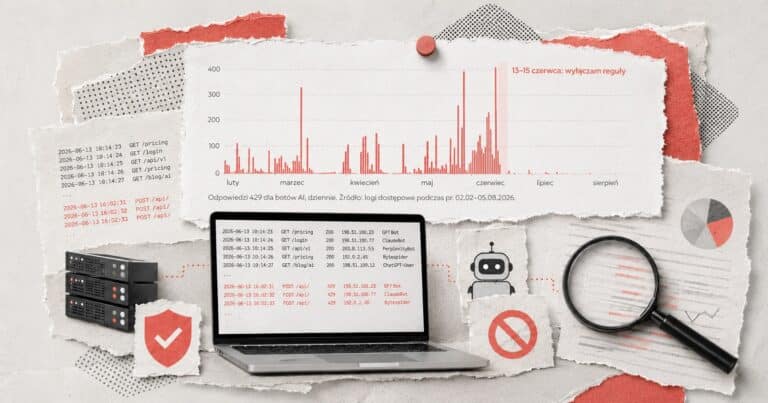
- August 5, 2026Server log analysis and AI visibility: 1.8 million requests. Until mid-June, my firewall rules returned status 429 to AI bots: GPTBot got it 2,615 times and OAI-SearchBot 834 times. Googlebot never did.
- June 25, 2026AI Performance in Bing Webmaster Tools: grounding queries. Free data on when Copilot cites your pages. Grounding queries, citation share and intent on four of my sites in different niches.
How to read
Ground rules for the notes
My sites are an SEO blog, a food blog, my agency’s site and travel guides in Polish, English and German. I have their server logs and Search Console data, plus access to AI model APIs.
I write up the results here as short notes. Each one answers one question and has a date, a method in a few sentences and the number it rests on. I mark hypotheses as hypotheses. If something doesn’t work out, I’ll write that down too.
“As of” The line at the top of each note says what period the numbers cover. When I repeat a measurement, I’ll add the new result with its date and won’t delete the old one.
One site isn’t the market These are observations from my sites, not an average for the whole web, so keep that in mind when you draw your own conclusions. In each note, I say how much data a conclusion rests on.
Confirmed bots only A confirmed bot comes from an address its operator publishes. I don’t count fakes with the same user agent. I describe the exceptions in the notes, for example Claude Code, which has no IP list.
Tools · 6
Try it yourself
You can run some of these measurements on your own site with my free tools. They work without an account, and your server logs and Search Console exports stay in your browser.

AI Bots in Logs
Which AI bots really visit your site?
You enter: a server log file. It stays in your browser.

Who typed these Search Console queries?
Which Search Console queries look like prompts and tool footprints?
You enter: a Search Console export (ZIP or CSV). It stays in your browser.
Can AI bots read your site?
What does your robots.txt let AI bots do?
You enter: a domain or the text of your robots.txt.
Is your site in Common Crawl?
Has your site made it into the archive AI models learn from?
You enter: a domain.
Are you in Google’s Knowledge Graph?
Does Google know you as an entity?
You enter: a person’s name, a company name or a kgmid.
Entity Observatory
How does your site describe a person or a company?
You enter: a page URL, JSON-LD code or a Wikidata QID. It also compares sameAs with Wikidata.




Plus two lists: the What bot is this? lookup (182 bots and user agents) and the AI knowledge cutoff dates table (how recent AI models’ data is).
If you’d like a measurement like this for your brand, get in touch. I can show you, for example, how ChatGPT, Gemini and AI Mode see it.